
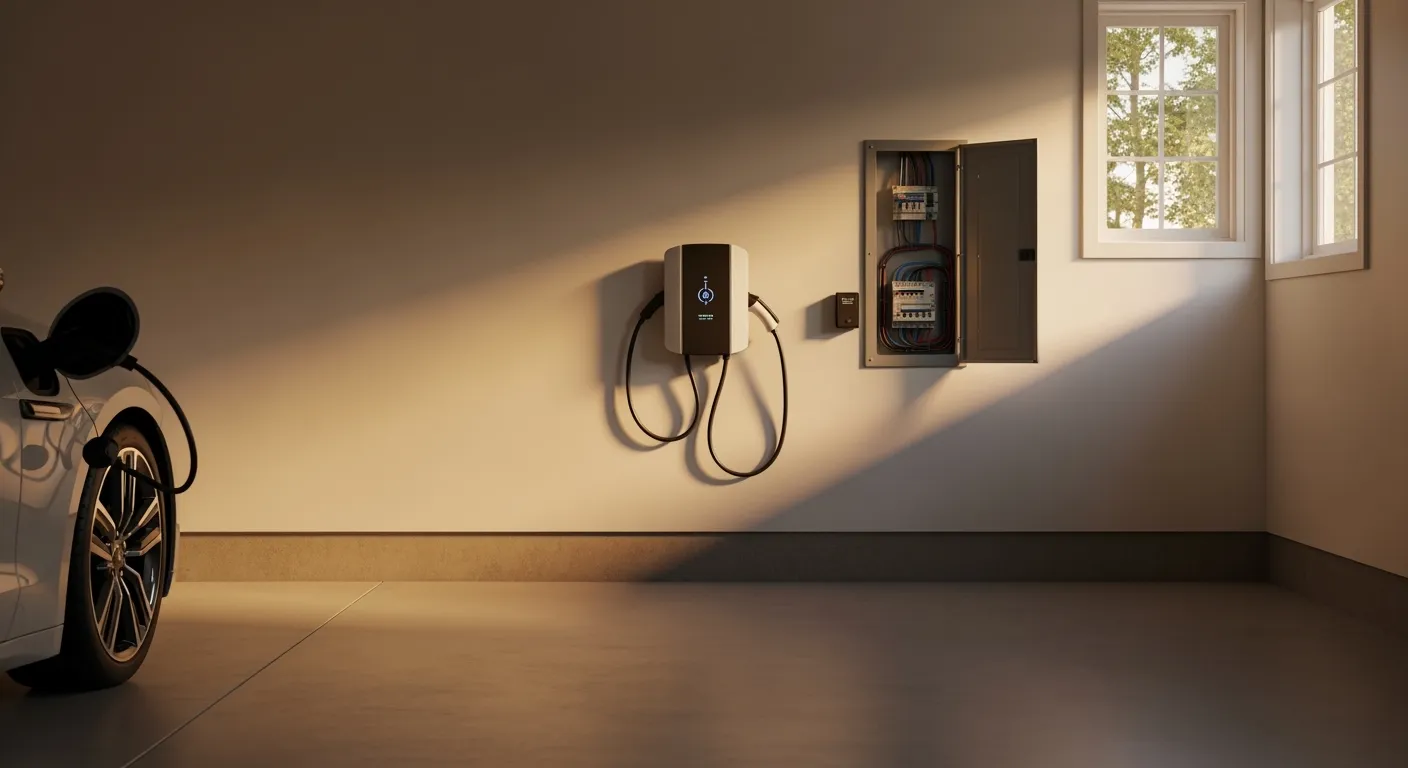
Buying an EV is exciting. Finding out your electrical panel might need a costly upgrade is not.
A lot of homeowners assume a Level 2 charger automatically means a bigger panel, a major rewiring project, and a much larger bill. Sometimes that is true. Often, it isn’t. In many homes, you can install a Level 2 charger without replacing the panel by using a load management system.
This is the part people usually don’t hear enough about. A smart load management setup can make EV charger installation much more affordable, faster to complete, and easier on your home’s existing electrical system. If your house already has other heavy loads like air conditioning, electric heat, a hot tub, or even sauna electrical equipment, this matters even more.
Let’s walk through how it works, where it makes sense, and why it can save real money.
A Level 2 charger uses 240 volts and charges much faster than a standard wall outlet. That’s great for daily life. You plug in at night and wake up to a full battery instead of waiting all weekend.
The problem is that your electrical panel has limits.
Every home has a maximum electrical capacity, often 100 amps, 125 amps, or 200 amps. Your panel already supports lighting, appliances, HVAC, laundry, kitchen circuits, and whatever else has been added over the years. In older homes, especially, there may not be much spare capacity left on paper.
When an electrician evaluates EV charger installation, they don’t just look for an empty breaker space. They perform a load calculation. That tells them whether your panel can safely handle the new charger along with everything else in the home.
If the numbers are tight, the traditional answer has been: upgrade the panel.
That can be expensive. Depending on the home, a panel upgrade may involve a new service, utility coordination, permits, feeder work, and repairs to finished walls. In some cases, it snowballs quickly.
This is where load management changes the conversation.
A load management system monitors how much electricity your home is using in real time and adjusts the EV charger accordingly.
Here’s the simple version.
If your house is using very little power, the charger can run at a higher rate. If your dryer, oven, heat pump, and hot water tank all kick on at once, the system reduces charging power or pauses charging temporarily. Once the household demand drops, charging resumes.
So instead of treating the charger like a fixed new load, the system treats it like a flexible one.
That flexibility is the whole point.
Your EV usually sits parked for hours. It doesn’t need to charge at maximum speed every minute of the night. A load management system takes advantage of that idle time and works within your home’s real capacity instead of forcing a service upgrade right away.
Think of it like traffic control.
Without load management, your electrician has to assume the EV charger may draw its full rated load while everything else in the house is also running. If that total exceeds safe panel capacity, the upgrade discussion starts.
With load management, the charger becomes responsive. It uses only the power your system can safely spare at that moment.
That means a 100-amp or 125-amp service that looks “full” on paper may still support a Level 2 charger in practice, provided the load management equipment is approved, installed properly, and matched to the home’s electrical setup.
It doesn’t work in every situation. I should be honest about that. Some homes are already maxed out, poorly configured, or due for a service upgrade anyway. But many homeowners are surprised to learn they have a middle option between “do nothing” and “replace the whole panel.”
A homeowner buys an EV and wants a Level 2 charger in the garage. The house has an older 100-amp panel, electric dryer, and a busy kitchen. At first glance, a panel upgrade seems likely.
After a proper load calculation, the electrician installs a charger with an energy management device that monitors whole-home demand. Overnight, when usage drops, the charger runs normally. During heavier periods, it throttles down.
Result: the homeowner gets faster charging without paying for a full service upgrade.
This one comes up more than you’d think. A house already has hot tub electrical equipment, and now the owners want EV charger installation too.
Hot tubs are significant loads. Add an EV charger and the panel numbers get uncomfortable fast. But the hot tub doesn’t necessarily run at peak demand all the time, and the car mostly charges while the household is quiet.
With a load management setup, the system prioritizes safe total demand. Instead of rebuilding the whole service, the homeowner gets a controlled solution that works around actual usage patterns.
A homeowner is already working with a renovation electrician for a basement remodel or garage update. It’s the perfect time to think ahead about EV charging.
Maybe the existing service is borderline. Maybe the renovation includes new circuits, sauna electrical additions, or upgraded appliances. A smart electrician can look at the whole picture and design the EV charger installation with load management from the start.
That usually costs less than doing the project in stages and discovering capacity issues later.
Let’s be direct. For most homeowners, cost is the deciding factor.
A panel upgrade can add thousands of dollars to an EV charger project. Sometimes much more, depending on utility work and site conditions. A load management system usually costs far less than replacing the panel and service equipment.
That savings can show up in several ways:
Less labor
Fewer materials
No full panel replacement
Less coordination with the utility
Fewer repairs to walls or finished spaces
Faster project timelines
There’s also a less obvious savings: avoiding overbuilding.
If your actual charging needs are modest, a full electrical service upgrade may be more than you need right now. A managed charging setup solves the immediate problem without forcing a larger capital project before it’s necessary.
For many households, that’s the sweet spot.
People hear “reduced charging output” and worry they’ll end up with a slow, frustrating system.
Usually, that fear doesn’t match real life.
Most EVs spend many hours parked overnight. Even if charging power varies, there is often plenty of time to add the energy needed for daily driving. If you drive 40 to 80 kilometers a day, you typically don’t need the charger blasting at full power all night.
Load management systems make use of those long parking windows. The charger uses available capacity when the house is quiet and backs off when bigger household loads take priority.
That’s efficient in the way that actually matters: the car is ready when you need it, and the house stays within safe limits.
This is not a DIY shortcut.
A load management system only makes sense when it is designed and installed by a licensed electrician who understands load calculations, code requirements, charger compatibility, and panel conditions. That part is non-negotiable.
A proper installation should include:
The electrician needs to evaluate the service size, panel condition, existing loads, circuit availability, and charger requirements. Guessing is a bad idea here.
The load management hardware and EV charger should be approved for the application and installed according to manufacturer instructions and local code.
Even smart systems rely on traditional electrical fundamentals. The wiring still has to be right. The breaker still has to be right.
Indoor or outdoor location, conduit routing, clearances, ventilation, and physical protection all matter.
For homeowners in Vancouver and surrounding areas, that usually means working with a licensed electrician who knows the permit process and local expectations. It’s one of those things that feels boring until something goes wrong. Then it feels very important.
This is also why people often look for licensed electrician and insured electrician credentials first. They should. EV charging is not the place to cut corners.
You don’t need to diagnose it yourself, but a few signs suggest load management may be worth exploring:
You have a 100-amp or 125-amp panel
Your panel is fairly full, but not unsafe or obsolete
You want Level 2 charging without a major upgrade
You have other large loads like electric heat, a dryer, hot tub, or sauna
You’re planning electrical work already, such as a renovation
You want to keep upfront costs under control
A professional assessment is still the only real answer. The same company that handles residential electrical services often sees these situations every week, so they can usually tell quickly whether managed charging is a smart fit.
And while this post is aimed at homeowners, the principle isn’t limited to houses. In commercial electrical services, load management is also used to make EV charging more practical where electrical capacity is limited or expensive to expand.
Not every electrician approaches EV charger installation the same way. Some jump straight to a panel upgrade. Sometimes that’s correct. Sometimes it’s just familiar.
Ask these questions:
Can you perform a load calculation before recommending a panel upgrade?
Do you install EV chargers with load management systems?
Which charger and energy management products do you work with?
Will you handle permits and inspection?
Are you licensed and insured?
Have you installed chargers in homes with 100-amp service or existing heavy loads?
You want someone who looks at options, not just the biggest job on the table.
That applies whether you’re hiring for EV work, residential electrical services, a renovation electrician, or specialty projects like hot tub electrical and sauna electrical installations. Good electrical planning is about solving the actual problem, not defaulting to the most disruptive fix.
If you want a Level 2 charger, don’t assume your only path is a panel upgrade.
Load management systems give many homeowners a simpler option. They monitor total power use, adjust charging automatically, protect the electrical system, and often cut installation costs by a meaningful amount. In the right home, they turn a complicated project into a manageable one.
The important thing is getting a proper assessment from a licensed electrician who understands EV charger installation and knows how to design around real household demand.
That’s the difference between hearing “you need a whole new panel” and hearing “here’s a safer, less expensive way to do it.”


Eagle Power delivers professional electrical services for residential and commercial properties, ensuring safety and excellence with licensed experts.
.png)

