
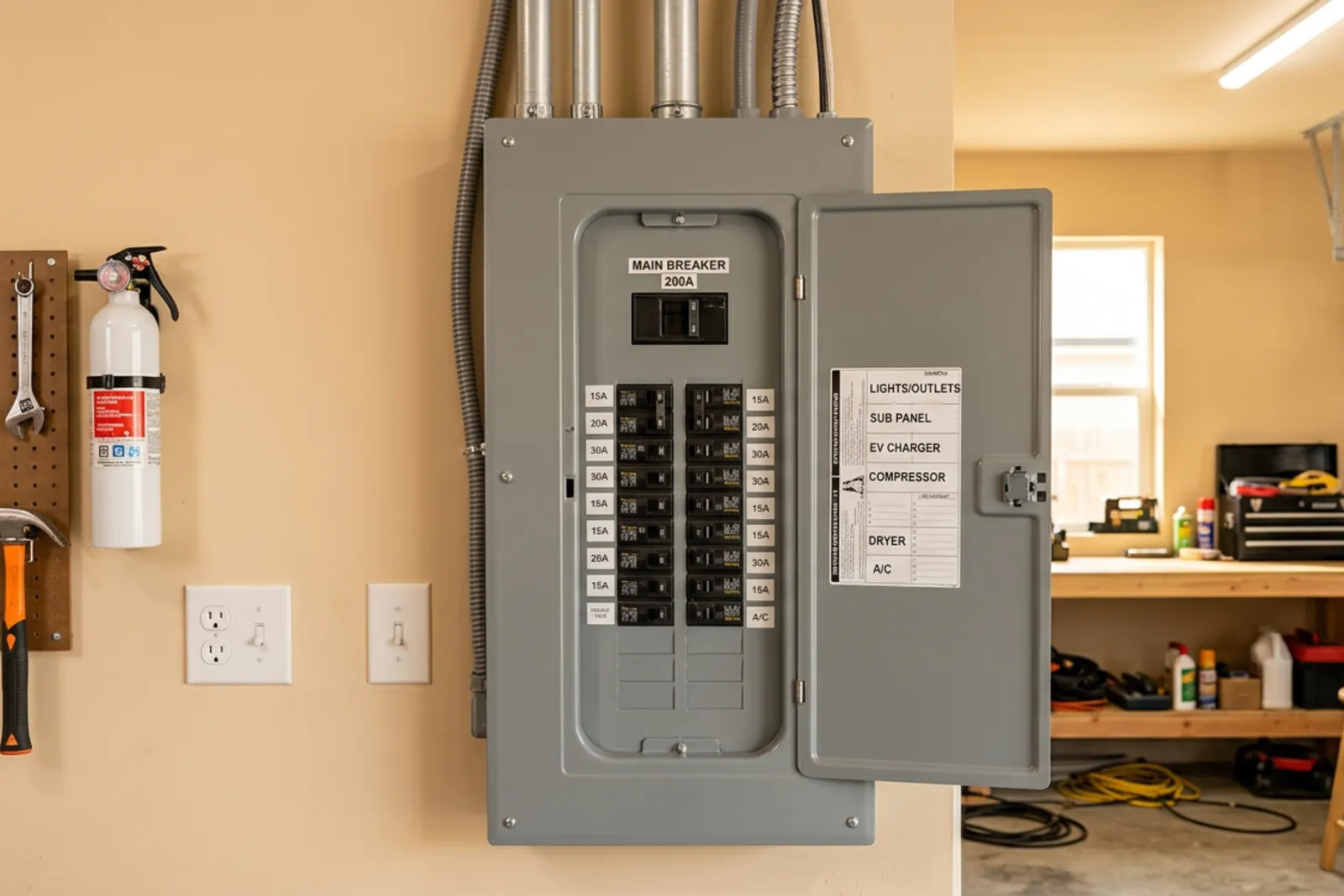
100A vs. 200A Electrical Service: When Vancouver Homeowners Should Upgrade
Learn when to upgrade from 100A to 200A electrical service for EV chargers, heat pumps, and renovations. Contact Eagle Power today.
September 14, 2026
Many older homes in Greater Vancouver were built when a household’s electrical needs were fairly modest. A few lights, a refrigerator, a stove, perhaps a clothes dryer. That was usually manageable on a 100-amp electrical service.
Homes use power differently now. A Level 2 charger in the garage, a heat pump replacing gas heating, an induction range, a finished basement, and a home office can add up quickly. If you are planning any of these changes, the question is not simply whether your current panel still works. It is whether your service has enough safe capacity for the way you live now and the changes you expect to make later.
A 100-amp service is not automatically unsafe or inadequate. Plenty of smaller homes operate safely on 100 amps. But for many Vancouver-area renovations and electrification projects, moving to 200-amp service is the more practical long-term decision.
What does 100A or 200A service actually mean?
The amp rating describes the maximum amount of electrical current your home’s incoming service is designed to supply. That service includes more than the breaker panel in the basement or garage. It may include the meter base, service conductors, mast or conduit, main disconnect, and utility connection.
A 100-amp service can supply up to 100 amps of electricity at a given time. A 200-amp service has double that capacity.
This does not mean every appliance constantly uses electricity at full power. In fact, homes are designed around the idea that many loads will not run at their maximum level at the same time. An electrician performs a load calculation to estimate realistic demand based on the home’s size, existing equipment, heating type, appliances, and planned additions.
Still, capacity matters. A home may have open spaces in its panel but lack the service capacity to safely support another major load. That distinction catches people off guard. More breaker slots do not automatically mean more available power.
A quick comparison: 100-amp vs. 200-amp service
A 100-amp service is common in houses built before about 1980, though age alone does not determine capacity or safety. It may be sufficient for a compact home with gas heat, gas hot water, modest appliance use, and no plans for large electrical additions.
A 200-amp service is common in newer construction and major renovations. It gives homeowners more room for modern equipment, separate circuits, and later improvements without revisiting the whole service connection.
Consideration100-amp service200-amp serviceTypical home ageOften found in older homesCommon in newer or substantially renovated homesBasic lighting and appliancesUsually adequateEasily supportedLevel 2 EV chargingMay require careful load managementUsually easier to accommodateHeat pumps and central A/CMay strain available capacityMore room for heating and cooling loadsSecondary suiteCan be restrictiveBetter suited to added circuits and demandFuture renovationsLimited flexibilityMore planning roomHot tub or sauna circuitsMay require other compromisesGenerally more practicalResale and insurance concernsDepends on condition and equipmentOften better matched to current expectations
The panel rating is only one part of the story. A well-maintained 100-amp breaker panel can be safer than a damaged or poorly installed 200-amp panel. The right decision comes from an assessment of the complete electrical system, not a guess based on the panel door.
Why electrical demand has changed in Greater Vancouver homes
Electrification is changing household load calculations. British Columbia has traditionally relied heavily on electricity for space and water heating, and that makes service capacity especially relevant in the region.
A house that once used gas for heat, cooking, and hot water may now be adding electric alternatives. Each change can make sense on its own. Together, they can push a 100-amp service close to its practical limit.
EV charger installation
Home charging is often the first reason homeowners start asking about panel upgrades. A Level 2 charger is much faster than plugging an EV into a standard receptacle, but it requires a dedicated 240-volt circuit and can draw a substantial continuous load.
For example, many Level 2 charger installations use a 40-, 50-, or 60-amp circuit, depending on the charger and vehicle charging settings. The charger does not necessarily draw the full breaker rating, but it must be designed as a continuous load. That affects the calculation.
A 100-amp service may still support an EV charger if the home’s other loads are low enough. In some cases, an electrician may recommend an energy-management device that reduces or pauses vehicle charging when the home approaches its available capacity. This can be a sensible solution when a full service upgrade is difficult or premature.
But if the home also has electric heat, a dryer, range, hot water tank, and a planned heat pump, load management can become a patchwork answer. A 200-amp upgrade may cost more upfront, yet it can spare you from having to redesign the system after the next renovation.
Heat pumps and air conditioning
Heat pumps are efficient, but they are not electrically invisible. Their demand depends on the unit size, outdoor temperature, backup heat, and system design. Central air conditioning also needs a dedicated circuit and draws significant power during operation.
The tricky part is that a home’s electrical demand is rarely tidy. A heat pump may run while someone is cooking, drying laundry, charging a vehicle, and using an electric water heater. Motors can also create startup demand that causes lights to dip in an already stressed system.
A proper load calculation accounts for this. It is not enough to look at the nameplate amperage of one piece of equipment and compare it to the main breaker.
Suites, basement finishing, and larger renovations
Adding a secondary suite changes the electrical picture fast. Even a modest suite can introduce new lighting, receptacles, kitchen equipment, laundry, bathroom ventilation, and heating loads. If the renovation includes a separate panel, new metering arrangement, or submetering, careful planning is needed early.
The same applies to basement finishing. What starts as “just a rec room” can become several new circuits, a wet bar, an electric fireplace, a bathroom, and a home office. A renovations electrician should review service capacity before drywall goes up. It is much easier to plan a service upgrade alongside a renovation than to reopen finished walls later.
Workshops, hot tubs, saunas, and high-draw appliances
A workshop with a welder, compressor, or large tools can require dedicated circuits. So can an induction range, wall oven, electric dryer, or larger laundry setup.
Hot tub wiring and sauna wiring need particular attention. These installations are exposed to moisture, require specific disconnecting and protection requirements, and can add meaningful demand to the home. A qualified hot tub electrician or sauna electrician should assess the whole service, not simply add a breaker because there appears to be room in the panel.
Signs your home may need a service upgrade
Electrical issues do not always mean you need 200-amp service. A tripping breaker might point to a faulty appliance, an overloaded branch circuit, or a connection problem. Still, several signs deserve a professional inspection.
Frequent breaker trips under normal use are one of the clearest warnings. A breaker should trip when it detects overload or fault conditions. Resetting it repeatedly without finding the cause is a bad habit, and it can hide a serious issue.
Flickering or dimming lights when a large appliance starts can also indicate a problem. A brief, slight dimming may happen in some homes when a motor starts, but noticeable or persistent changes need attention. Loose connections, undersized conductors, panel issues, or service limitations are all possible causes.
Fuse panels are another reason to book an assessment. Fuses can work safely when correctly installed and maintained, but many older fuse panels lack the capacity, condition, or configuration needed for a modern home. Never replace a blown fuse with a larger size simply to stop it from blowing. That can allow wiring to overheat.
Other signs include:
A planned EV charger, heat pump, hot tub, sauna, or electric appliance conversion
A major kitchen, basement, or suite renovation
A panel with no practical space for new circuits
An insurer asking for electrical updates or documentation
Older aluminum branch wiring, especially in homes built before the mid-1970s
Corrosion, heat damage, burning smells, buzzing, or visible damage at the panel
An outdated service connection that needs work before new equipment can be added
Burning smells, a hot panel cover, crackling, repeated breaker trips, or water near electrical equipment are reasons to stop using the affected equipment and seek urgent help. Emergency electrical service is appropriate when there is an immediate risk of shock, fire, or loss of essential power.
Older wiring deserves its own assessment
A 100-amp panel does not always mean the house has dangerous wiring. Likewise, a 200-amp panel does not guarantee that every circuit in an older house is in good condition.
Homes in North Vancouver, Vancouver, and surrounding communities often have layers of electrical work from different eras. An addition may have newer wiring while the original section still has older components. Some homes have aluminum branch-circuit wiring, while others contain knob-and-tube wiring in concealed areas. Insurance providers may have specific requirements for these systems.
Home rewiring is a separate project from a service upgrade, though the two are sometimes completed together. Upgrading the main service can provide capacity, but it does not automatically replace deteriorated branch wiring, ungrounded receptacles, or poorly modified circuits.
That is why an on-site review matters. Licensed electricians can inspect the panel, service entrance equipment, visible wiring, grounding and bonding, and the home’s current loads before recommending the scope of work.
Permits, inspections, and utility coordination
Panel upgrades and service upgrades in Greater Vancouver generally require permits and inspections. Electrical work must comply with the applicable BC electrical code and local requirements. Depending on the job, coordination with the electrical utility may also be needed.
A straightforward panel replacement is different from increasing the service from 100 amps to 200 amps. A true service upgrade may require changes to the meter base, service conductors, conduit, mast, weatherhead, or underground service connection. The utility may need to disconnect and reconnect power, and the work must be scheduled around that process.
The sequence often looks like this:
A licensed electrician assesses the existing service and completes a load calculation.
The electrician determines whether a panel replacement, service upgrade, load-management system, or another solution is appropriate.
Permits are arranged, and utility requirements are confirmed if the incoming service needs changes.
The installation is completed, with a planned power outage where necessary.
The work receives the required permitted inspection before final energization or sign-off.
A properly permitted inspection protects the homeowner. It creates a record that the work was performed to code and can be useful for insurance, future renovations, and property sales.
How much does a 100A to 200A upgrade cost?
There is no honest flat price for every Vancouver electrician job. The cost depends heavily on the condition and location of the existing equipment.
Factors that affect pricing include whether the service is overhead or underground, how accessible the panel and meter are, whether the mast or conduit needs replacement, the distance to the utility connection, panel location, grounding upgrades, drywall or exterior repairs, permit fees, and the complexity of the load calculation.
A simple panel change inside an accessible utility room is very different from replacing an aging service mast on a multi-storey home, relocating equipment, and coordinating an underground utility connection. The latter can involve more labour, materials, scheduling, and restoration work.
Ask for a written scope that explains what is included. It should distinguish between a panel upgrade and a complete service upgrade. Those phrases are often used interchangeably, but they are not always the same job.
How long does an upgrade take?
The hands-on work may be completed in a day for some straightforward projects, but the overall timeline can be longer. Permitting, inspection availability, utility coordination, equipment lead times, and the need for service-connection changes all affect scheduling.
Homeowners should also plan for a temporary outage. Refrigeration, internet equipment, garage doors, medical devices, security systems, and heating controls may be affected. An electrician can explain the expected outage window and any steps you should take before work begins.
When 100 amps may still be enough
There is a tendency to treat every 100-amp service as obsolete. That is too simplistic.
A smaller home with gas heating and hot water, no EV, no air conditioning, and limited renovation plans may operate comfortably on 100 amps. If the panel is in good condition, circuits are properly protected, and a professional load calculation confirms available capacity, there may be no immediate need to upgrade.
Still, homeowners should think beyond today’s appliance list. If you expect to buy an EV within a few years, install a heat pump, convert gas appliances to electric, or add a suite, doing the service upgrade once as part of planned electrical renovations is often less disruptive than tackling it in stages.
The practical choice for most growing electrical needs
For a basic older home with modest loads, 100 amps can remain workable. For a home headed toward electric heating, home charging, a suite, a hot tub, or a major renovation, 200 amps is usually the more comfortable starting point.
The best next step is an assessment by licensed and insured electricians who can calculate your actual demand and review your future plans. They can tell you whether you need a full service upgrade, a panel replacement, a managed EV charging solution, or targeted electrical repairs.
Electricity is one part of a house where guessing rarely pays off. A code-compliant, properly sized service gives you room to use your home without constantly wondering which appliance needs to stay off while another one runs.
Need a licensed electrician?
Free consultations across Greater Vancouver — and 24/7 emergency service.
Get a Free Quote