
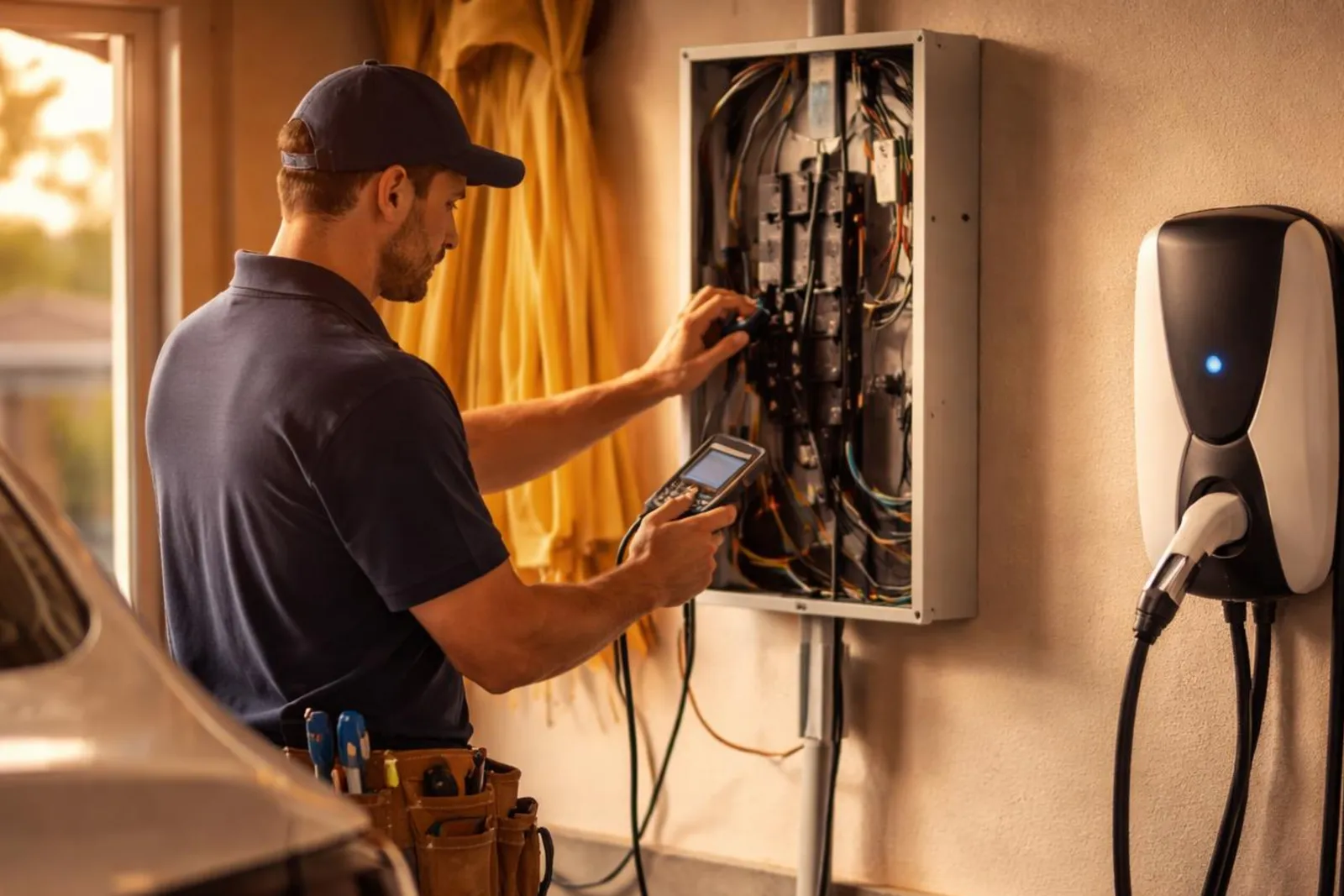
Can Your Existing Electrical Panel Support a Level 2 EV Charger?
Can your electrical panel support a Level 2 charger? Learn what affects capacity and when panel upgrades may be needed. Read more with Eagle Power.
August 28, 2026
A lot of homeowners start with the same question: can I add a Level 2 charger without replacing my electrical panel?
Sometimes the answer is yes. Sometimes it is no. And pretty often, the honest answer is, "probably, but only after a real load calculation."
That last part matters. In North Vancouver and across Greater Vancouver, many homes are adding several big electrical loads at once. A heat pump goes in. Someone swaps a gas range for induction. Then comes home charging for an EV. On paper, each upgrade makes sense. Put together, they can push an older panel harder than people expect.
The good news is that a new charger does not automatically mean a full service replacement. A lot of homeowners hear "EV charger" and brace for a major project. In reality, some homes can support a Level 2 charger with existing capacity, some need smart load management, and some do need panel upgrades or service upgrades. The right path depends on the numbers, not guesswork.
What a Level 2 charger actually asks from your panel
A Level 2 charger uses 240 volts and delivers much faster charging than a standard wall outlet. For most homes, that means overnight charging instead of waiting all day or stretching things over multiple days.
The electrical demand varies by charger and by the vehicle, but many residential setups use a 30-amp, 40-amp, 50-amp, or 60-amp circuit. That does not mean the charger pulls the full breaker rating continuously, but it does mean the circuit has to be sized correctly for a continuous load.
This is where people get tripped up. They look at the panel, see a few open breaker spaces, and assume they are ready for EV charger installation. Open spaces help, but they are only part of the story. Space in the panel is not the same thing as spare capacity in the service.
A panel can have room for a new breaker and still be too loaded for a Level 2 charger. The opposite can also happen. A home might have enough electrical capacity overall, but the panel needs reconfiguration, a subpanel, or a different charger setup to make it work cleanly and code compliant.
The difference between panel space and electrical capacity
This distinction is worth slowing down for.
Panel space is physical room for breakers. Capacity is how much electrical demand the home can safely support.
Think of it like a bookshelf. Empty shelf space does not tell you how much weight the whole thing can carry. Your electrical system works the same way.
When licensed electricians assess home charging, they usually look at two big questions:
Is there a practical way to connect the charger, physically and safely?
Does the home have enough calculated load capacity for that added demand?
That second question is the one that determines whether your existing setup can handle a Level 2 charger.
Why older homes often hit limits sooner
In North Vancouver, plenty of homes still run on 100-amp service. Some have had partial updates over the years, maybe electrical repairs here, a kitchen renovation there, maybe lighting design changes, hot tub wiring, or home rewiring in one section but not another. That patchwork is common. It is not automatically unsafe, but it can make planning more complicated.
A 100-amp service that worked fine ten years ago may feel tight today. Modern homes use electricity differently. Heat pumps, induction ranges, electric dryers, larger kitchens, sauna wiring, hot tub electrician work, and EV charging all add pressure. Even when those loads do not run at the same exact moment, the system still has to be evaluated by code calculation, not by optimism.
I have seen homeowners assume, very reasonably, that because they have never tripped the main breaker, they must have plenty of room. That is not always true. Breakers do not tell the whole story about long-term loading, continuous use, or what happens when you stack several new appliances into one upgrade cycle.
What an electrician checks before saying yes or no
A proper assessment is more than a glance at the panel door. For residential electrical services, the electrician should review the whole picture, including:
The service size, such as 100A, 125A, 150A, or 200A
Panel condition, age, brand, and available breaker spaces
Existing major loads like heating, range, dryer, hot tub, or sauna
Planned upgrades such as a heat pump, induction cooking, or air conditioning
Charger size and how fast you actually need the vehicle to charge
Wiring route, breaker availability, and equipment location
Permit and inspection requirements
That load calculation is the foundation. In many cases, it shows that a home can support EV charger installation with no service change at all. In other cases, it shows the margin is too small and the homeowner is better off with load management or a panel upgrade.
A Level 2 charger does not always mean a service upgrade
This is the part many people find reassuring.
There are really three common outcomes.
Outcome 1: Your panel can handle it as is
This is the easiest scenario. The home has enough available capacity, the panel is in decent shape, and there is a straightforward way to run the new circuit. The charger gets installed, permitted, and inspected. Done.
This happens more often in newer homes, larger services, or homes where the big loads are still gas-fired.
Outcome 2: Your panel can handle it with load management
This is the middle ground, and honestly, it is often the smartest option.
Load management systems monitor household demand and reduce or pause EV charging when the house is already drawing heavily. When demand drops, the charger ramps back up. For homeowners who charge overnight, this can work very well. The car still gets charged, but the electrical system does not have to be oversized just to cover a rare peak moment.
If you are adding a heat pump and a Level 2 charger around the same time, load management deserves a serious look. It can reduce the need for immediate panel upgrades and keep the project more practical.
Outcome 3: You need panel upgrades or service upgrades
Sometimes the math is just too tight. Maybe the home has an older 100-amp service, electric heat, an induction range, a dryer, and plans for hot tub wiring. Maybe the panel itself is outdated or full. In that case, a larger electrical project may be the right answer.
That could mean replacing the panel, increasing service capacity, or doing related electrical renovations so the system is ready for current and future demand.
No homeowner loves hearing that bigger work is needed. Still, there is one upside. If you already know more electrification is coming, it often makes sense to plan once instead of patching things in stages.
Heat pumps, induction, and EV charging change the calculation
This is where the conversation gets real for a lot of households.
Each upgrade by itself may look manageable. Together, they can push a borderline system past its comfort zone.
A heat pump changes the heating load profile. Induction cooking adds a strong 240-volt load in the kitchen. A Level 2 charger introduces a predictable but significant continuous load, often at night. If you are also thinking about electrical renovations, home rewiring, or other high-demand additions, the panel assessment should happen early, not after equipment has been chosen.
That timing matters more than people think. If the electrician gets involved early, they can often suggest options that save money or avoid rework. Maybe a different charger size makes more sense. Maybe load management solves the issue. Maybe service upgrades should be bundled with a planned renovation. Maybe a homeowner does not need the fastest charger available because their driving pattern does not justify it.
Speed is nice. Matching the system to real life is better.
How much charging speed do you actually need?
This question gets ignored because fast sounds good. Of course it does.
But many drivers do not need the largest home charger their panel could theoretically support. If you drive modest daily distances and plug in overnight, a lower-amperage Level 2 charger may fully meet your needs while putting less pressure on the electrical system.
That matters because charger size affects circuit size, load calculation, and sometimes whether a panel upgrade is needed at all.
A good electrician should ask about your actual driving habits. Commute length, battery size, when the vehicle is home, and whether you have one EV or plan for two, all of that changes the best solution.
Home charging is partly about electrical design, but it is also about behavior. A right-sized setup often beats the biggest possible setup.
Signs your panel may be close to its limit
No single sign proves the answer, but these are common clues that a home may need a closer look:
The house has 100-amp service and several recent electric upgrades
The panel is full or uses tandem breakers heavily
You already have electric heat, a dryer, and a large range
You are planning a heat pump, hot tub electrician work, or sauna electrician work
Lights dim when large appliances start
The panel is older, shows heat damage, or has a history of electrical repairs
You are already discussing service upgrades or home rewiring for other reasons
A well-kept older panel is not automatically a problem. Still, if several of those signs apply, the odds go up that you will need more than a simple breaker addition.
Why permits and inspection matter for EV charger installation
This is one area where shortcuts are a bad bet.
A Level 2 charger is a substantial electrical load. It should be installed by licensed electricians, with the right permit, the correct breaker and wire size, and a permitted inspection where required. That protects safety, but it also protects resale value, insurance clarity, and future troubleshooting.
Homeowners sometimes ask if a handy friend can install the charger to save money. My view is simple. For something that draws serious power for hours at a time, you want code compliant work. You want insured electricians. You want someone who knows local requirements in North Vancouver and the rest of Greater Vancouver. This is not the place for improvisation.
The same logic applies if your charger install is tied to a renovation. If you are already hiring a renovations electrician for kitchen work, lighting design, or electrical renovations elsewhere in the home, it is smart to coordinate the EV charger at the same time.
What to ask before hiring someone to assess your home
You do not need to be an expert, but a few questions can tell you a lot.
Ask whether the contractor will perform a proper load calculation, not just a quick estimate. Ask whether the work will be permitted and inspected. Ask whether they handle panel upgrades and service upgrades if the assessment shows they are needed. Ask whether they have experience with both EV charger installation and broader residential electrical services.
In British Columbia, many homeowners also look for a Master Electrician or an FSR Contractor, especially when the project may involve more than a simple circuit addition. That is not about fancy titles. It is about making sure the person evaluating your panel actually understands the code, the calculations, and the practical realities of electrical work in Greater Vancouver.
If you are comparing contractors, watch for anyone who gives a firm yes or no without reviewing the existing service and major loads. A confident answer after a five-second glance is not reassuring. It is a red flag.
What about emergencies or existing electrical problems?
If your panel already shows warning signs, deal with that first.
Buzzing, heat, burning smells, flickering tied to load, corrosion, water exposure, or breakers that trip repeatedly should be checked before moving ahead with home charging. That is not just a charger issue. It is basic electrical safety.
Sometimes homeowners searching for EV charger installation uncover older problems that need electrical repairs or maintenance anyway. It is annoying, yes. But better to find them during planning than after a new continuous load has been added.
If there is an urgent issue, this is where emergency electrical service or even 24/7 emergency service matters. Stabilize the system first, then plan the charging setup.
The short answer most people want
Can your existing panel support a Level 2 charger?
Maybe. A lot of homes can. Some need a smarter charger strategy. Some need panel upgrades.
The deciding factor is not wishful thinking, breaker count, or what a neighbor did. It is a proper load calculation, a look at the panel condition, and an honest review of everything else the home is trying to power.
If you live in North Vancouver or anywhere in Greater Vancouver and you are adding a heat pump, induction, or other major electric loads, it is worth assessing the whole system before choosing charger equipment. That order matters. It can keep the project safer, simpler, and cheaper.
And if there is one thing I would not skip, it is this: get a code compliant assessment from licensed and insured electricians who do this work regularly. For EVs, panels, and modern home electrification, the details are where the answer lives.
Need a licensed electrician?
Free consultations across Greater Vancouver — and 24/7 emergency service.
Get a Free Quote