
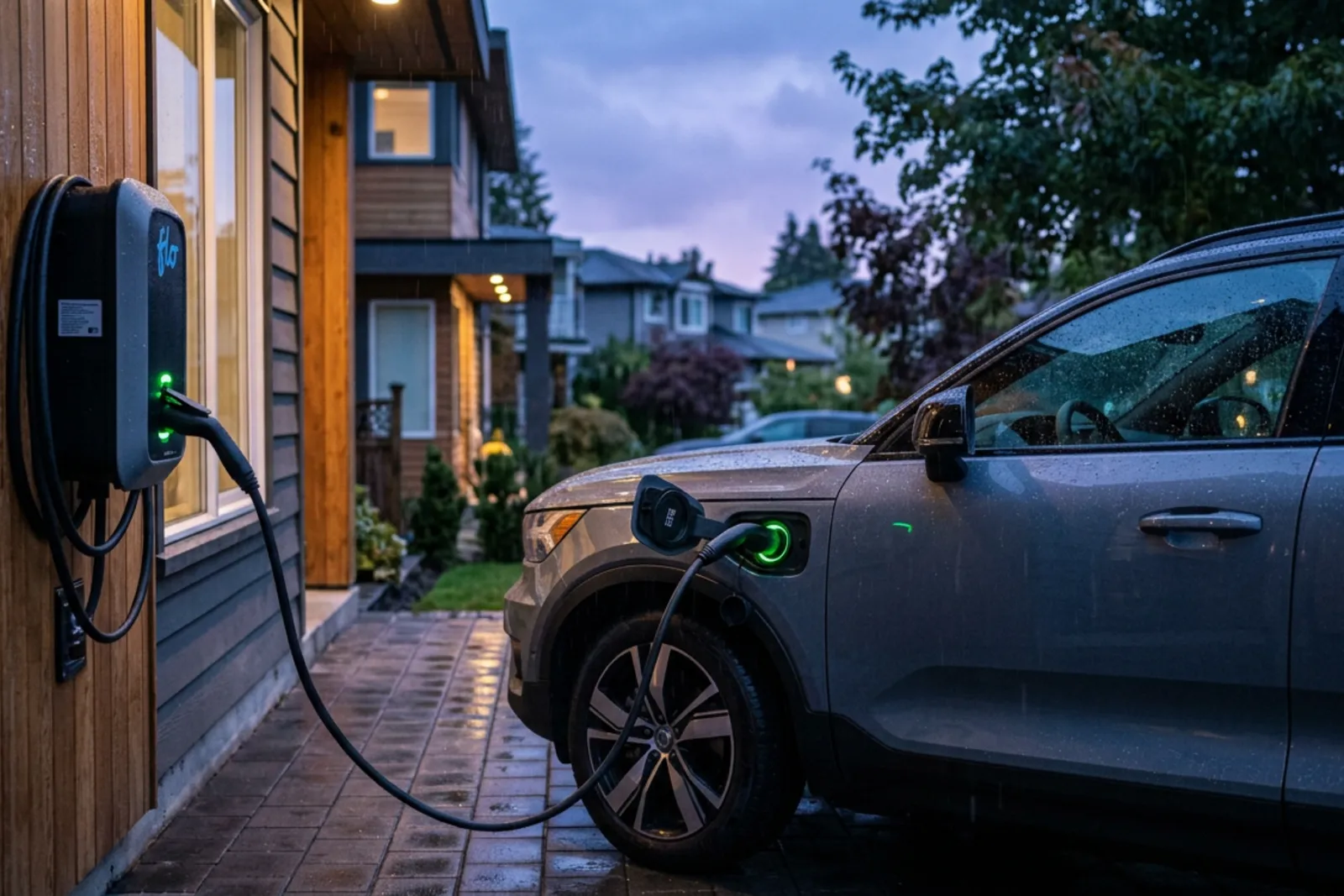
How to Choose the Best Level 2 Home EV Charger in Canada
Learn how to choose a Level 2 charger for your Canadian home, from charging speed to permits and panel capacity. Get expert guidance today.
September 9, 2026
A Level 2 charger is one of the most useful upgrades an electric vehicle owner can make at home. It turns charging from an occasional planning exercise into a routine: plug in after work, wake up with a full battery, and spend less time at public charging stations.
Still, choosing a home charger in Canada is not as simple as picking the highest-amperage model on sale. Cold weather, outdoor installation, electrical panel capacity, connector type, utility rates, permits, and the realities of a shared condo garage all matter. A charger that looks excellent in a product listing can be a poor fit for a particular home.
For buyers in Greater Vancouver, the good news is that the region’s moderate temperatures are generally easier on EV charging equipment than the deep winter conditions of the Prairies or northern Canada. The wet climate creates its own concerns, though. Outdoor weather protection, proper mounting, cable storage, and a code compliant installation deserve serious attention.
This guide explains what to look for in a Level 2 charger, how much charging speed you actually need, and what to address before booking an EV charger installation.
What is a Level 2 EV charger?
Most electric vehicles come with a portable charging cord that plugs into a standard 120-volt household outlet. This is Level 1 charging. It works, but it is slow. Depending on the vehicle, a Level 1 connection may add roughly 5 to 8 kilometres of driving range per hour.
A Level 2 charger uses a dedicated 208- or 240-volt circuit, similar to the type used for an electric dryer, range, or hot tub. A typical Level 2 charger can add roughly 25 to 70 kilometres of range per hour, depending on the charger’s output and the vehicle’s onboard charging limit.
That difference matters most when:
You drive daily and want predictable overnight charging.
Your EV has a larger battery pack.
Your household has more than one electric vehicle.
You want to charge during lower-cost overnight utility periods.
You rely on your vehicle for commuting, client visits, or family transportation.
“Charger” is the common term, but the equipment mounted on your wall is technically called EV supply equipment, or EVSE. The actual battery charger is built into the vehicle. In everyday conversation, though, Level 2 charger is perfectly clear.
Start with your vehicle’s charging capability
Before comparing chargers, check your EV’s maximum Level 2 charging rate. This is a common point of confusion.
A charger may be rated for 48 amps, but your vehicle may only accept 32 amps or 40 amps on Level 2 power. In that case, buying the larger charger will not make that vehicle charge faster. It may still make sense for a future EV, but it should be a deliberate decision.
Charging power is commonly expressed in kilowatts:
Charger outputApproximate power at 240 voltsTypical use16 amps3.8 kWPlug-in hybrids, lower daily mileage24 amps5.8 kWSmaller EVs, overnight home charging32 amps7.7 kWA practical choice for many households40 amps9.6 kWFaster overnight charging for many EVs48 amps11.5 kWHigher-capacity installations and future planning
A 32-amp charger is enough for many drivers. If you arrive home at 6 p.m. and leave at 7 a.m., you have a long charging window. You rarely need to replace a full battery every night.
Higher output becomes more appealing when the vehicle has a large battery, the household’s schedule is tight, or two drivers need to share one charging circuit. The right choice is based on your routine, not the highest number on the box.
The electrical panel sets the real limit
A Level 2 charger needs a dedicated circuit. For continuous loads such as EV charging, electrical design must account for the fact that the equipment can run for hours at a time.
As a practical example, a 32-amp charger usually requires a 40-amp circuit. A 48-amp charger generally requires a 60-amp circuit. The electrical calculations are more involved than that, because the existing panel load, heating system, cooking equipment, dryer, hot tub wiring, air conditioning, and future loads all affect what the home can safely support.
An older home may have a 100-amp electrical service. That does not automatically rule out home charging. Some homes can safely support a modest charger after a proper load calculation. Others need panel upgrades, service upgrades, or energy-management equipment before a higher-output charger can be installed.
This is where licensed electricians are worth involving early. A site assessment can answer questions that no online product comparison can settle:
Is there enough capacity in the existing panel?
Is the panel physically full, even if the service has spare capacity?
Is the garage far from the electrical room?
Will a long cable run increase installation cost?
Is a panel upgrade already planned for a renovation?
Are there other large electrical loads that may operate at the same time?
Trying to solve a capacity issue by simply installing a larger breaker is dangerous and not code compliant. Breakers protect wiring. Their size must match the conductor size, equipment requirements, and electrical design.
Hardwired or plug-in Level 2 charger?
Many home chargers are available in two forms: hardwired or plug-in.
A hardwired charger connects directly to the electrical circuit. It is a clean, permanent installation and is often required for chargers operating above 40 amps. It also removes one connection point from the system, which can be useful in a damp garage or exterior location.
A plug-in charger typically uses a 240-volt receptacle, often a NEMA 14-50 outlet. This can make it easier to replace the charger later or take it with you when moving. It can be a sensible option for a 32- or 40-amp unit if the receptacle and installation are designed for continuous EV charging.
The outlet itself matters. A low-cost receptacle that works fine for an occasional RV connection may not hold up well under repeated high-current charging. Heat at the plug, discolouration, looseness, or a burning smell are warning signs that need immediate attention. Stop using the equipment and arrange electrical repairs rather than hoping the issue disappears.
For many homes, hardwiring is the straightforward long-term option. For others, a properly installed receptacle is completely reasonable. The installation method should fit the charger rating, location, and homeowner’s plans.
Cold, rain, and outdoor installation in Canada
Canadian buyers should look beyond marketing phrases such as “all-weather.” Check the equipment’s environmental rating and installation instructions. A charger installed outdoors must be approved for that use and mounted where it can avoid unnecessary exposure to standing water, impact damage, and snow accumulation.
In Greater Vancouver, rain is the bigger day-to-day concern. A weatherproof enclosure does not mean careless installation is acceptable. Good outdoor installations consider the wall condition, conduit routing, drainage, cable position, and protection from vehicles.
Cable management is easy to overlook until the first wet winter. A charging cable should not sit in puddles, drag across a walkway, or create a trip hazard. Choose a charger with an integrated holster or cable hook, or install a separate approved holder where appropriate.
Cold weather also affects charging behaviour. Most modern EVs manage battery temperature automatically, but cold batteries accept energy more slowly. The charger may be working normally even when the vehicle limits charging speed to protect the battery. Parking in a garage and scheduling charging before departure can help the vehicle warm the battery using grid power rather than draining the battery on the road.
For detached garages, exterior walls, and parking pads, a professional installation should account for wiring methods approved for the location. Outdoor electrical work needs the right raceways, fittings, supports, and weather-rated equipment. A charger is not simply an appliance mounted near an outlet.
Smart features that are actually useful
Smart charger features range from genuinely practical to mildly distracting. The basics are enough for many households: reliable charging, a clear status light, and a cable that remains flexible in cool weather.
That said, a few connected features can make home charging easier to manage.
Scheduled charging
If your utility has time-of-use or overnight pricing, scheduling lets you set charging to begin during lower-cost periods. Even where electricity rates are not strongly time-based, scheduled charging can reduce demand during busy household hours.
Energy monitoring
A charger that records kilowatt-hours can help you understand charging costs, track business mileage, or split electricity use between family members. It is useful information, though it should not replace a utility meter for formal billing arrangements.
Load management
This feature can be particularly valuable in homes with limited electrical capacity. Some chargers or energy-management systems monitor household demand and reduce EV charging temporarily when other loads are high. That may avoid the need for immediate service upgrades in certain situations.
It is a practical solution, but it needs careful design. Compatibility depends on the charger, electrical panel, monitoring equipment, and local requirements.
Multiple-user access
For households sharing a charger, app controls can allow more than one driver to check charging status. In a multi-unit building, access controls may also prevent unauthorized use. This is more relevant to commercial electrical services, workplaces, and strata properties than to a single-car garage.
One note of caution: a smart charger should still work safely when Wi-Fi drops out. Internet connectivity is convenient. It should not be the only thing standing between you and a charged vehicle.
Connector compatibility in Canada
Most non-Tesla EVs sold in Canada use the J1772 connector for Level 2 charging. Tesla vehicles can use Tesla-specific equipment or an adapter, depending on the model and charger type.
Before buying, confirm:
Your vehicle’s Level 2 connector type.
Whether an adapter is included, approved, and suitable for regular use.
The charger’s maximum output compared with the vehicle’s onboard charging limit.
Whether the unit is certified for use in Canada.
Look for recognized Canadian electrical certification marks, such as CSA, cUL, or cETL, as applicable. Avoid uncertified electrical equipment, especially for high-current loads installed outdoors or in attached garages. A bargain charger is not a bargain if a failed component damages the vehicle, overheats a connection, or creates an insurance problem.
Installation costs and what changes the price
The cost of EV charger installation varies widely because homes vary widely. The charger itself is only one part of the project.
A straightforward installation may involve a short run from a nearby panel to an attached garage wall. A more complex project may require a detached garage feeder, trenching, a new subpanel, drywall repair, a long conduit route, or a service upgrade.
Common cost factors include:
Charger amperage and circuit size
Distance from the electrical panel
Panel space and available service capacity
Hardwired versus receptacle installation
Interior, exterior, or detached-garage location
Concrete, finished walls, crawl spaces, and access challenges
Permit requirements and permitted inspection costs
The need for a subpanel, load-management system, or panel upgrade
If your home is already undergoing electrical renovations, it may be efficient to plan for EV charging at the same time. A renovations electrician can install conduit or a future circuit while walls are open. Even if you are not ready to buy an EV, roughing in the infrastructure during a remodel is often far less disruptive than reopening finished spaces later.
The same idea applies to larger household projects. If you are planning home rewiring, sauna wiring, hot tub electrical work, or a significant lighting design update, ask whether the service capacity should be assessed as one project rather than a series of unrelated additions.
Permits, inspections, and strata approval
A permitted installation protects the homeowner, future buyers, and everyone using the electrical system. Requirements differ by municipality and property type, but electrical work in Greater Vancouver commonly requires permits and inspection through the authority having jurisdiction.
A licensed electrical contractor can identify the required process and complete work to the applicable code. Do not assume a charger purchased online comes with installation approval. Product certification and installation permits are separate issues.
Condo and strata owners have another layer to navigate. The parking stall may be limited common property rather than privately owned space. Electrical capacity may be shared, and cable routes can pass through common areas. Approval may require a proposal covering the charger model, power source, installation path, metering, maintenance responsibility, insurance, and removal obligations if the owner moves.
It can feel bureaucratic, because it is. But shared-building charging needs a fair plan. One resident’s convenient installation should not create a cost, capacity, or safety issue for everyone else.
A practical buying checklist
Before ordering a Level 2 charger, work through these questions:
How many kilometres do you drive on a typical day?
How many hours is the vehicle parked at home overnight?
What Level 2 charging rate can your EV accept?
Does your electrical panel have enough capacity for the planned circuit?
Will the charger be indoors, outdoors, or in a shared garage?
Is the unit certified for Canadian installation?
Do you need scheduling, energy monitoring, or load management?
Is the cable long enough without being excessively long and hard to store?
Does the manufacturer provide accessible warranty support in Canada?
Are permits, inspection, and strata approval required?
The most suitable Level 2 charger is usually not the flashiest model. It is a certified unit with the right output, a durable cable, useful controls, and support that will still exist if something goes wrong.
The bottom line
Level 2 home charging makes EV ownership simpler, but the charger purchase and the electrical installation should be treated as one decision. A 40- or 48-amp unit may look appealing, yet a smaller charger can be the smarter choice if it meets your overnight needs without forcing costly panel upgrades.
For many Greater Vancouver households, a properly sized, weather-rated charger on a dedicated circuit will provide years of dependable service. The safest path is to choose certified equipment, confirm your vehicle’s charging limit, assess panel capacity before buying, and have the installation completed by insured electricians with the right licence and permit process.
Home charging should feel routine. With the right planning, it does.
Need a licensed electrician?
Free consultations across Greater Vancouver — and 24/7 emergency service.
Get a Free Quote