
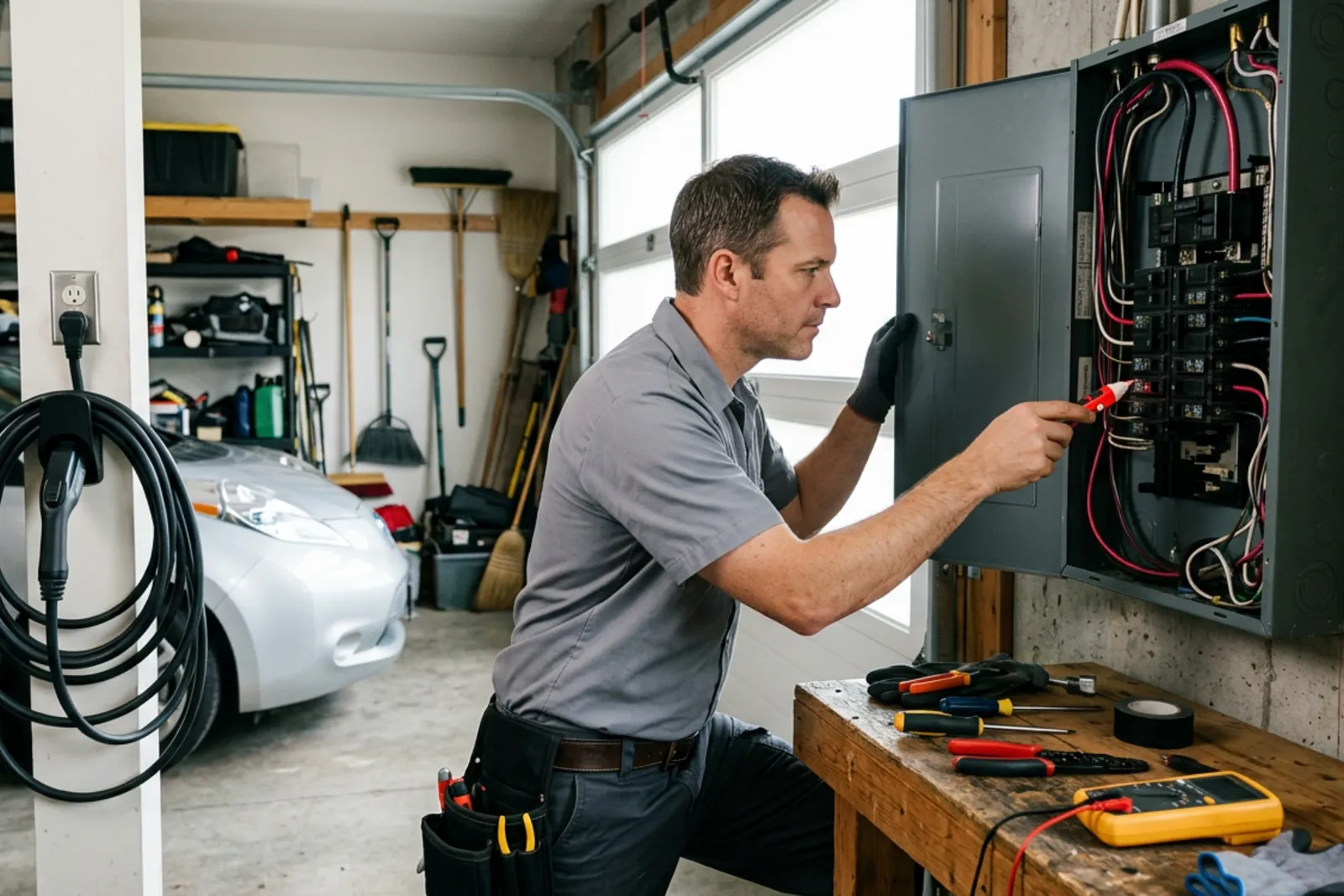
EV Charger Installation Without a Service Upgrade: What Homeowners Should Know
Learn when EV charger installation can work without a service upgrade. Explore load calculations, energy management, permits, and safe Level 2 options for your home.
November 25, 2026
Adding home charging does not automatically mean replacing your electrical panel or upgrading your electrical service. Many homes can support a Level 2 charger with a dedicated circuit. Others can accommodate charging by using energy management to keep household demand within safe limits.
The right answer depends on your home’s electrical load, the equipment already installed, and how much charging you actually need. A 100-amp service, for example, is a reason to assess capacity carefully, not proof that an expensive upgrade is unavoidable.
For homeowners in North Vancouver and across Greater Vancouver, the most useful first step is an electrical assessment. Choosing the highest-output charger can wait.
Start With Your Daily Charging Needs
Your charger needs to replace the energy you use between charging sessions. It does not necessarily need to refill an empty battery as quickly as possible.
Level 1: Slow, but sometimes sufficient
Level 1 charging uses a standard 120-volt outlet. It may suit a plug-in hybrid, a short commute, or a vehicle that remains parked at home for long periods.
Its limitation is speed. Drivers who regularly cover longer distances may find that Level 1 cannot replace their daily energy use during an overnight charging window.
The outlet and circuit still need to be suitable for sustained charging. An older, loose, or damaged receptacle should not be treated as ready simply because the charging cord fits. Avoid extension cords and follow the vehicle and charging equipment manufacturers’ instructions.
Level 2: A practical home charging option
A Level 2 charger uses a dedicated 240-volt circuit. It can typically replenish an EV overnight, although charging time depends on battery size, the vehicle’s onboard charger, equipment output, and how depleted the battery is.
Higher output is not always better. A moderate-output charger may comfortably cover your daily driving while placing less demand on the electrical service.
For example, a driver traveling 40 kilometers a day may need substantially less charging power than someone returning home after a long highway trip every evening.
DC fast charging: Usually unnecessary at home
DC fast charging is mainly intended for public, commercial, and fleet locations. Its power requirements and installation costs generally make it impractical for a residence.
For most households, the decision is whether Level 1 is sufficient or how to supply Level 2 charging safely.
Why a Load Calculation Matters More Than the Panel Label
The service rating describes the electrical capacity supplied to your home. A load calculation assesses the demand that existing equipment and the proposed charger place on that service under applicable electrical rules.
That distinction matters. Empty breaker spaces do not prove that spare service capacity exists. A full panel also does not automatically mean the incoming service needs to be enlarged.
An electrician will consider loads such as electric heating, cooking equipment, water heating, laundry equipment, and other substantial electrical equipment. EV charging is a significant continuous load, so circuit and equipment sizing must account for sustained operation.
Older homes in neighborhoods such as Lynn Valley and Upper Lonsdale may have 100-amp services supporting equipment added over several decades. Some will need changes before charging can be installed. Others may have workable capacity, especially with an appropriately sized charger or approved energy management system.
The calculation should guide the recommendation. Guessing from the home’s age or panel size is not enough.
Three Ways to Supply a Level 2 Charger
Once the existing load is understood, the installation usually follows one of three paths.
A dedicated circuit without energy management
If the service has sufficient calculated capacity and the panel can support the installation, a dedicated circuit may be all that is required.
The circuit must be sized for the charger’s configured output. The vehicle, charger, wiring, and protective equipment must work together within their ratings.
This can be the simplest solution, but it still requires proper assessment, permitting, installation, and any required inspection.
A dedicated circuit with energy management
An EV energy management system controls charging so the home stays within its available electrical capacity.
Depending on the system, it may monitor household demand and reduce or pause EV charging when other loads increase. Charging resumes or increases when capacity becomes available.
Imagine arriving home while electric cooking, laundry, and heating equipment are operating. Charging may temporarily slow or stop. Later, when household demand drops, the vehicle can receive more power.
For many drivers, that interruption is barely noticeable because the vehicle remains plugged in overnight. However, a household with high overnight heating demand or a short charging window needs a closer assessment.
Energy management can cost less than a service upgrade. The equipment must be suitable for the application, correctly configured, and accepted under the applicable electrical requirements. A basic scheduling feature in a phone app is not automatically a substitute for an approved capacity-management system.
A service upgrade
A service upgrade may be appropriate when existing demand leaves too little usable capacity, managed charging cannot meet the household’s needs, or substantial electrical additions are planned.
Future projects matter. A heat pump, electric water heater, hot tub, or second EV may change the most practical solution.
Panel upgrades and service upgrades are related but different. Replacing a panel does not necessarily increase the capacity supplied by the utility. Increasing service capacity can involve utility coordination and changes to service equipment or conductors.
Ask what the proposed work changes and why it is needed.
What Affects Installation Complexity and Cost?
Two homes with the same service rating can require very different installation work.
Panel condition and available space
The panel must be suitable for the new circuit. Damage, overheating, obsolete equipment, or incompatible components may require attention before the charger is connected.
A subpanel can sometimes address circuit-space limitations. It does not create additional service capacity.
Charger location and wiring route
A charger close to the panel generally needs less wiring than one at the far end of a driveway. Distance is only part of the picture, though.
Finished walls, concrete, buried routes, detached garages, and exterior surfaces can increase labor and material requirements. Outdoor equipment also needs to be appropriate for its environment.
Think about everyday use. The cable should reach the vehicle’s charging port without creating a trip hazard or interfering with doors and walkways.
Hardwired versus plug-in equipment
Both arrangements can be code compliant when properly designed and installed.
Hardwired equipment generally supports higher-output applications and avoids a receptacle connection that can wear or loosen. Plug-in equipment may be easier to replace or relocate, but the receptacle, circuit, and protective requirements still need careful attention.
The decision should reflect charging needs and installation conditions, not convenience alone.
A Sensible Assessment and Installation Process
A little planning before buying equipment can prevent expensive changes later.
Describe your charging routine. Share your daily driving distance, vehicle model, usual arrival and departure times, and any plans for another EV.
Assess the electrical system. Have a qualified electrical contractor confirm the service rating, calculate the load, and evaluate panel condition and circuit space.
Choose the location and wiring route. Consider parking position, cable reach, weather exposure, and the work needed to run the circuit.
Compare suitable options. Review a dedicated circuit, reduced-output charging, approved energy management, and a service upgrade where necessary.
Confirm approvals before proceeding. Check rebate requirements before purchasing, then arrange permits, installation, and required inspection.
Clear photographs can help with a preliminary estimate. Photograph the panel with its normal door open so the breaker layout and labels are visible, along with the proposed charger location.
Do not remove the panel’s protective cover or expose wiring for a photograph. A site visit may still be needed to verify conditions that pictures cannot show.
Permits and Safety in British Columbia
Level 2 EV charger installation involves a dedicated 240-volt circuit and requires an electrical permit in British Columbia. EV charging equipment installation is not work covered by a homeowner electrical permit. Use a licensed electrical contractor who can arrange the appropriate permit and inspection process through the authority having jurisdiction.
Licensed electricians should select equipment and installation methods that meet applicable requirements. Insurance is another sensible qualification to verify when choosing a contractor.
Unpermitted work can create code compliance concerns and complicate insurance claims. Keep permit information, equipment documentation, and inspection records with your home maintenance records.
Many straightforward single-family installations can be completed in one working day once approvals and materials are ready. Long wiring routes, wall repairs, utility work, or shared-building installations can take longer.
If an existing charging connection becomes unusually hot, shows discoloration, or produces a burning smell, stop using it and arrange an electrical assessment. Repeated breaker trips also need investigation, not repeated resets.
Strata Charging Starts With Building-Wide Planning
Installing a charger in a strata parkade is different from installing one beside a single-family garage. Parking areas may be common property, electrical capacity is often shared, and approval involves strata governance.
In British Columbia, strata corporations with five or more strata lots are generally required to obtain an electrical planning report, subject to applicable deadlines and exemptions. This report helps the strata understand electrical capacity and future demands.
An EV Ready plan addresses charging infrastructure more specifically. These documents have different purposes, so a strata should confirm what its legal obligations and intended rebate program require.
Load management is often central to shared charging. A building may lack capacity for every stall to charge at full output simultaneously, yet still support practical overnight charging when available power is distributed among vehicles.
Planning should also address ownership, maintenance, electricity billing, and future expansion. Infrastructure and chargers can then be installed in phases instead of treating each request as an isolated project.
Workplaces Need to Consider Access and Billing
Commercial charging begins with the same capacity question, but operating needs differ.
Employee vehicles may remain parked for an entire shift, making shared, moderate-output charging practical. Customer parking may require different charging limits or access arrangements.
Networked equipment can support usage tracking, access control, and payment collection where those functions are needed. It also introduces software, connectivity, and ongoing operating costs.
Sites with production machinery, refrigeration, or other heavy loads need electrical planning that accounts for those demands. Commercial electrical services should be scoped around actual site use rather than a desired charger count alone.
Check Rebates Before Buying Equipment
CleanBC Go Electric charging incentives are administered through BC Hydro and FortisBC, with eligibility depending on the property, equipment, and program category.
Single-family properties and certain small residential buildings may qualify for equipment and installation support. Multi-unit buildings have separate categories that can include planning, shared electrical infrastructure, and chargers. Workplace programs may provide support per eligible station.
Funding availability, eligible models, approval requirements, and rebate amounts can change. Some equipment manufacturers or models may be excluded, so confirm the exact product’s eligibility rather than assuming every Level 2 charger qualifies.
Where preapproval is required, buying equipment or starting work too early can make the project ineligible. Check the application sequence before making commitments, and retain the required invoices and installation records.
Choose Capacity That Fits Your Life
The best home charging installation is one that safely replaces the energy you use within the time your vehicle is parked.
That may mean a dedicated circuit with no service changes. It may mean energy management that pauses charging during busy household periods. In some homes, a service upgrade is the more practical long-term choice.
Start with a load calculation, consider future electrical needs, and compare solutions against your actual driving routine. Those steps give you a sound basis for deciding what to install, without assuming the largest charger or biggest upgrade is necessary.
Need a licensed electrician?
Free consultations across Greater Vancouver — and 24/7 emergency service.
Get a Free Quote