
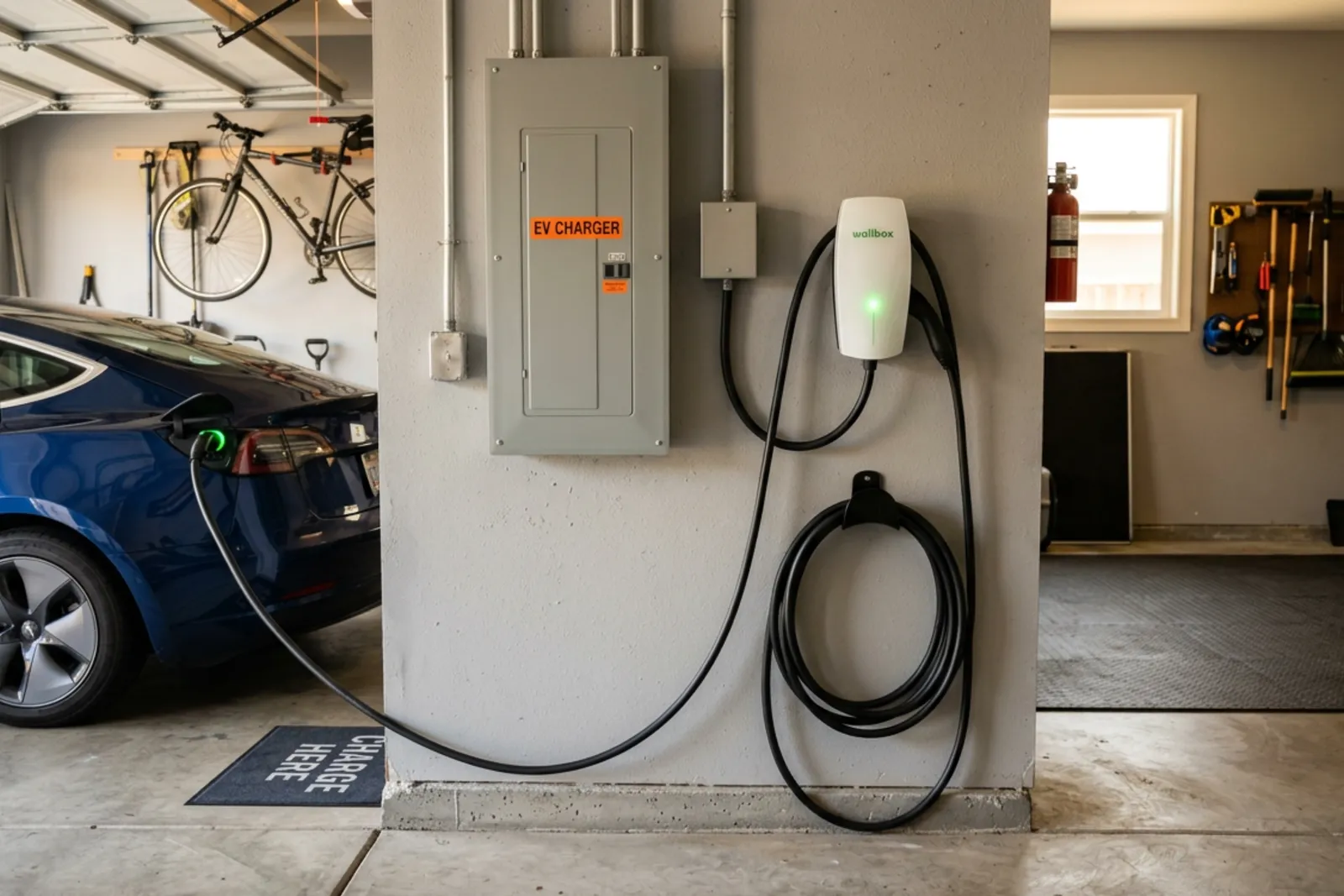
EV Charger vs. EVEMS: When You Need a Panel Upgrade and When Load Management May Work
Learn when EV charger installation requires a panel upgrade or EVEMS load management. Plan a safe, code-compliant charging setup today.
September 18, 2026
Installing an EV charger at home or in a multi-unit building often starts with a simple question: “Do we have enough electrical capacity?”
The honest answer is that it depends. An electric vehicle charger can add a substantial continuous load to a home, apartment building, parkade, or commercial property. In British Columbia, that load has to be calculated under the BC Electrical Code (BCEC), documented for the permit, and installed so conductors, breakers, feeders, and services stay within their ratings.
Sometimes the answer is a service or panel upgrade. Sometimes an Electric Vehicle Energy Management System, usually called an EVEMS, can manage charging demand safely enough to avoid that upgrade. Those are very different paths, and an EVEMS is not a shortcut around electrical design or permitting.
Technical Safety BC’s Information Bulletin IB-EL 2023-05, Revision 3, explains the distinction in detail. Here is what property owners, strata councils, and facility managers should understand before planning an EV charger installation.
EVSE and EVEMS are different equipment
People often call the wall-mounted equipment an “EV charger,” which is understandable but slightly imprecise.
An Electric Vehicle Supply Equipment system, or EVSE, is the complete assembly that transfers electricity and exchanges information between the electrical branch circuit and the vehicle. It includes the charging cable, connector, control equipment, fittings, and related components. A Level 2 charger is a common example of EVSE.
An Electric Vehicle Energy Management System, or EVEMS, is a control system that manages the load created by EVSE. It may monitor power use, communicate with chargers, reduce charging output, or disconnect charging equipment when the building’s available capacity is limited.
Put plainly:
EVSE delivers electricity to the vehicle.
EVEMS controls when and how much electricity the EVSE can use.
A charger can exist without an EVEMS. An EVEMS, however, is generally installed because a property needs to control charging demand instead of simply adding the charger’s full rating to the electrical load calculation.
That distinction matters because the code requirements, documentation, and testing obligations change once load management enters the picture.
Why EV charging creates load-calculation questions
EV charging is treated seriously because it can run for hours at a time. A 40-amp Level 2 charger, for example, is not a casual plug-in appliance. It is a significant load that may operate overnight while heating, cooking, laundry, air conditioning, or other household loads are also in use.
For systems without EVEMS, BCEC requirements generally require EVSE loads to be added to the applicable service load calculation at a 100% demand factor. In practical terms, electricians cannot assume that vehicle charging will happen only occasionally or at convenient times.
For a new detached home, this calculation is part of the electrical design. For an existing home, it is part of deciding whether the existing service and panel can safely support the new circuit.
A property may have a 100-amp, 125-amp, 150-amp, or 200-amp service, but the service rating alone does not answer the question. The actual answer comes from a proper calculation that considers the home’s connected loads and the demand rules that apply to them.
A 200-amp panel can still be close to capacity. A 100-amp service may have enough calculated capacity for a modest charger in one home but not another. Electric heat, hot tubs, suites, air conditioning, induction ranges, workshops, and future renovations all change the picture.
This is why a licensed electrician should start with the load calculation, not with a promise that a particular charger will fit.
When a conventional EV charger installation needs an upgrade
A conventional installation has no active load management system. The EVSE has a dedicated branch circuit, and its load is included in the calculation at full demand.
If that calculation shows the service, feeder, or panel is overloaded, the property needs a different solution. This may involve:
A larger electrical service or service upgrades
A panel upgrade or new distribution equipment
Feeder upgrades between the meter, main panel, and subpanels
A lower-rated charging circuit, where practical
An EVEMS designed and accepted for the application
Upgrades are not always cheap, and they can be disruptive. In older homes, panel upgrades sometimes reveal other work that needs attention, such as undersized feeders, deteriorated equipment, grounding issues, or electrical renovations that were completed without enough capacity planning.
Still, an upgrade is often the cleanest long-term option. It creates real capacity for the EV charger and may support later additions such as heat pumps, electric water heating, a hot tub electrician’s new circuit, sauna wiring, or home rewiring work.
Load management is useful, but it should not be treated as automatically better than building adequate capacity. It is a technical solution to a technical constraint. In the right setting, it works very well. In the wrong setting, it can become a complicated system that needs more oversight than the property owner expected.
What an EVEMS actually does
An EVEMS keeps charging demand within a defined electrical limit. It does this through monitoring and control.
The code bulletin describes several common approaches.
Load switching
A load-switching system monitors electrical demand and disconnects the EVSE when another load needs the available capacity. For example, a system may allow either an EV charger or another large appliance load to operate, but not both at once.
This approach may be appropriate where a circuit has limited capacity and the loads are unlikely to be needed at the same time. The charger pauses while the other load operates, then resumes when capacity returns.
It sounds simple, but the electrical design still has to account for the greatest possible demand and for the current used by the monitoring and control equipment.
Load sharing
Load sharing is common where multiple chargers are connected to a shared electrical supply. The chargers communicate with each other and divide the available power among plugged-in vehicles.
If only one vehicle is charging, it may receive more power. If several vehicles connect, each one may receive less.
This can be a sensible approach in condo parkades, workplaces, and commercial sites where installing full-capacity circuits for every future parking stall would require a major service upgrade. The trade-off is charging speed during periods of high demand.
Dynamic load management
Dynamic systems monitor available capacity at a panel, feeder, switchboard, or service. They adjust the EVSE load based on what the rest of the building is using.
A building may have several vehicles charging at night, then reduce or pause charging if another large building load rises. The system’s purpose is to keep the actual electrical demand below the permitted limit.
This is powerful equipment, but it must be designed carefully. A load-management system is only useful if it measures the right loads, reacts reliably, and reaches a safe condition if communication or control fails.
The fail-safe requirement is the part that cannot be skipped
EVEMS installations must have a fail-safe, sometimes called a safe state.
The safe state is the condition that prevents the actual load from exceeding the ampere rating of the circuit, feeder, or service being protected. Depending on the design, the EVEMS may reduce charging current to a preset level or disconnect charging completely.
This requirement is not theoretical. EVEMS systems depend on current sensors, communications, software, controllers, contactors, and settings. Any of those elements can fail, be installed incorrectly, lose power, or be altered later. The system needs a predictable response when something goes wrong.
A properly designed system should not continue charging at an unsafe level because a sensor has failed or a communications connection has dropped.
For acceptance, the responsible qualified person or Registered Professional of Record must verify and test the EVEMS operation, including the fail-safe condition. Commissioning and testing records must be submitted before final inspection.
That paperwork may feel tedious, especially in a small home project. It exists for a reason. A charger that merely “seems to work” is not proof that the electrical system remains within code limits under every operating condition.
EVEMS can change the load calculation, but it does not erase it
One of the biggest misunderstandings around load management is the idea that an EVEMS means no load calculation is needed.
It does not.
Where a switching-type EVEMS is added to an existing circuit or feeder to use the BCEC load-management provisions, two calculations may be required:
A calculation that includes the EVSE load.
A calculation for the existing loads without the EVSE operating.
The governing demand is the largest simultaneous demand that can actually occur, plus the monitoring and control current used by the EVEMS.
The goal is to prove that the system limits the electrical demand safely, rather than simply assuming that people will charge at off-peak times.
Plug-in switching devices deserve extra caution. Some products connect through an existing receptacle, such as a dryer receptacle, then switch between the appliance and the EVSE. Because they alter branch-circuit characteristics and loads, they still require an electrical permit and load calculations. Their mounting, location, installation method, and protection must comply with the BCEC.
A plug-in device is not exempt from the rules simply because it feels consumer-friendly.
EV charger settings must be secured and marked
Many EVSE units have adjustable output settings. A charger may be capable of more than one maximum charging current, depending on its configuration.
The installed setting can be used for conductor sizing, overcurrent protection, disconnect sizing, receptacle configuration, and load calculations only when specific conditions are met. The manufacturer’s instructions must be followed, and the setting cannot be accessible to ordinary users.
Acceptable methods of restricting access can include an enclosure requiring tools, a locked door for qualified persons, or password-protected software limited to authorized users.
The equipment also needs a conspicuous, permanent warning label stating that the maximum charging current must not be adjusted. The label must identify the installed maximum charging current, the rating of the supplying overcurrent device, and the installed conductor size.
This may appear overly cautious until someone changes a charger setting after installation. Increasing a charger’s output without changing the breaker, conductors, or load calculation can create a fire risk. The label gives future electricians, homeowners, tenants, and maintenance staff information they need before touching the equipment.
Receptacles, breakers, and hard-wired chargers
The common 14-50R and 6-50R receptacles are rated for 50 amps. When cord-connected EVSE uses one of these receptacles, the overcurrent protection must be rated at 50 amps under the applicable BCEC rule.
That creates a practical constraint for 40-amp EV charging installations.
Some chargers require a 40-amp overcurrent device. Because there is no standard 40-amp receptacle configuration, those installations must be hard-wired. Installing a 14-50 receptacle on a 40-amp breaker conflicts with the requirement for the receptacle configuration and circuit rating to match.
This is a point where online advice can be unreliable. A receptacle may look familiar, and a plug may physically fit, but electrical work must be code compliant, not merely convenient.
Mechanical protection also matters. EVSE must be installed and guarded against damage. A charger placed in a vehicle’s likely path is asking for trouble. Good placement may involve mounting it on a side wall, locating it clear of parking movement, setting it back from curbs or parking stops, or installing guards or bollards.
The charging cable and conduit also need protection. A neat installation is usually safer, easier to maintain, and less likely to be damaged by vehicles, weather, or daily use.
Existing homes: why utility bills are usually not enough
For an existing service, the BCEC can allow the use of historical maximum-demand data from the electrical utility under certain conditions. Generally, no new loads can have been added during the previous 12 months.
The difficulty is that many residential utility bills show energy consumption in kilowatt-hours, or kWh. That tells you how much electricity a home used over a billing period. It does not show the highest demand at a particular moment.
Those are different measurements.
A home might use modest total energy in a month but still create a high evening peak when space heating, cooking, laundry, and EV charging happen at once. Using kWh as though it were peak demand can hide that risk.
For detached single dwellings, Technical Safety BC has separate guidance with a safety factor for limited cases where only kWh data is available. Outside those circumstances, kWh readings generally cannot replace maximum-demand data without a variance supported by a Registered Professional of Record.
When historical demand data is used, the new load calculation must be documented and the service must be labelled. The label needs to identify the new calculated kilowatt load, the rule used, the historical-data basis, and the date of the calculation. Any later load additions may require a new 12-month history before that approach can be used again.
Stratas and multi-unit buildings need early planning
EV charging in strata housing is rarely just an individual-owner decision.
Owners, tenants, and occupants generally need written strata approval before altering a strata lot or common property. That can include charger installation, even if the charger is intended for one resident’s parking stall. The electrical infrastructure may run through common property, connect to common electrical rooms, affect fire separations, or use capacity shared by the entire building.
Electrical planning reports can help stratas understand future charging needs, but they do not replace BCEC load calculations. A planning report may identify likely demand, estimate upgrade pathways, and support long-term budgeting. It cannot confirm that a specific charger installation is electrically safe or code compliant.
Multi-unit buildings also need to consider fairness and scalability. A system built for the first two EV owners should not make future installations impossible or force the strata into repeated, expensive alterations.
For many buildings, a phased design is more realistic. It may include spare conduits, space in distribution equipment, reserved electrical capacity where available, and an EVEMS built to support additional chargers later. The best choice depends on the building’s existing service, parking layout, electrical rooms, ownership structure, and expected adoption.
Documentation, approvals, and maintenance are part of the installation
EVEMS equipment must be approved under BCEC requirements. Field-assembled EVEMS requires particular attention because combining individually approved components does not automatically mean the assembled system is accepted as an EVEMS.
For projects outside the single-dwelling exception, sealed engineering drawings are generally required for the electrical permit submission. A Registered Professional of Record reviews the design, performance values, commissioning requirements, and maintenance needs.
If field-assembled equipment lacks an overall approval for use as EVEMS, it may need a variance and field evaluation or special inspection by a certification agency.
Buildings that require an electrical operating permit must retain the relevant records in the permit holder’s log. That includes installation instructions, maintenance instructions, plans, commissioning reports, repairs, and later changes.
This is especially relevant for commercial electrical services and large residential properties. The person maintaining the building years later needs to know what controls the chargers, what the safe-state settings are, and what changes could compromise the original design.
Choosing the right path
An EV charger installation should begin with a site-specific electrical review. The basic decision is straightforward:
If the existing service and distribution equipment have enough calculated capacity, install the EVSE on a properly sized, permitted circuit.
If capacity is insufficient, determine whether a service or panel upgrade is the sensible long-term answer.
If an EVEMS is being considered, make sure it is approved, properly designed, tested, documented, and capable of a safe fail state.
For homes and buildings across Greater Vancouver, the practical lesson is simple: charging equipment can be easy to buy, but safe integration with an electrical system takes planning.
A permitted inspection, correct load calculation, and qualified installation protect more than the charger. They protect the service equipment, the building, and everyone who depends on the electrical system working as intended.
Need a licensed electrician?
Free consultations across Greater Vancouver — and 24/7 emergency service.
Get a Free Quote