
Lighting Design and Service Upgrades for IMAX Theaters
Learn how IMAX theater lighting design and service upgrades improve safety, operations, and viewer experience. Explore key electrical considerations.
September 23, 2026
When people think about an IMAX theater, they usually think about the giant screen and the sound. Fair enough. That is the headline experience. But lighting has a quiet job that is easy to underestimate until it goes wrong.
A badly lit theater can ruin contrast, create reflections on the screen, distract the audience during key scenes, and make routine operations harder than they need to be. A well lit theater does the opposite. It helps guests settle in, supports safety, guides movement, gives staff control, and then almost disappears once the film starts. That disappearing act is harder than it sounds.
For theater owners, operators, developers, and facility managers, lighting design is rarely just a cosmetic decision. In many IMAX retrofits and new builds, it connects directly to service upgrades, controls, code compliance, and long term Electrical Maintenance. The electrical side of the project is where a lot of costs and scheduling problems show up, so it pays to think about it early.
Why lighting matters so much in an IMAX auditorium
IMAX magnifies everything. That includes mistakes.
In a smaller auditorium, a little spill light might be annoying but tolerable. In an IMAX room, even a modest reflection can become obvious because the screen is so large and the audience is meant to be visually absorbed. The whole point is immersion. If aisle lights are too bright, wall sconces are pointed the wrong way, or dimming curves are rough and uneven, viewers notice.
There is also a physiological side to this. Our eyes need time to adapt when moving from a brighter lobby into a dark auditorium. If that transition is clumsy, people spend the first few minutes of the film getting comfortable instead of paying attention. Good Lighting Design smooths out that shift with controlled pre show scenes, low glare fixtures, and careful brightness levels.
Then there is operations. Staff need enough light for cleaning, inspections, late seating, and emergencies. The room cannot be permanently dark. The trick is creating multiple lighting conditions for different moments, with each one doing exactly what it needs to do and no more.
The main lighting zones in an IMAX theater
A theater is not one lighting problem. It is several, stacked on top of each other.
Lobby and pre function spaces
This is where the audience first gets a feel for the venue. The lighting here needs to support wayfinding, ticketing, signage, concessions, and crowd flow. It usually runs brighter than the auditorium, but it should still prepare people for the darker environment ahead.
Color temperature matters more than many owners expect. If the lobby lighting is harsh and cold, the transition into the theater can feel abrupt. Warmer, more controlled light often works better, especially in evening showtimes.
Auditorium seating area
This is the most sensitive zone. Fixtures have to provide safe movement before and after the show, but once the feature begins, they cannot compete with the screen. Deep dimming performance is non negotiable here. Cheap dimming drivers tend to step, flicker, or cut out at low levels, and that looks amateur in a premium cinema.
Wall placement matters too. Even a properly specified fixture can cause trouble if it throws light across the audience sightline or onto reflective surfaces near the screen.
Aisles, steps, and exits
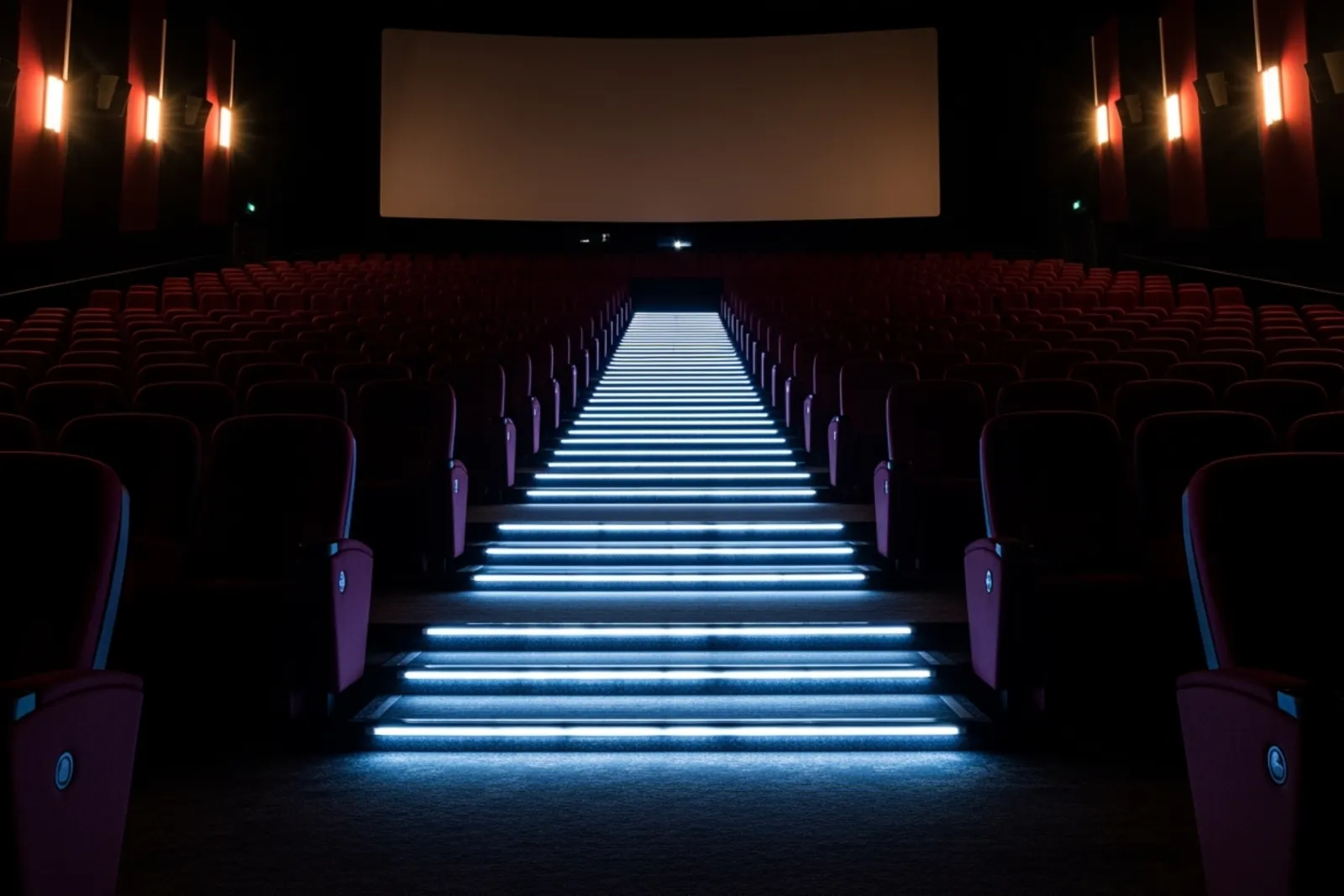
These lights are about safety first, but they still need restraint. Step lights, aisle markers, exit signs, and emergency lighting must meet code while staying visually quiet. That balance takes planning. Too little light is unsafe. Too much breaks the viewing experience. There is no shortcut around careful layout and testing.
Projection, control, and technical rooms
These areas are often treated like standard back of house rooms, but they are not quite standard. Staff may need task lighting, dedicated circuits, and power quality protection for sensitive equipment. The lighting should support maintenance and operation without causing glare on monitors or interfering with workflows.
Concessions, washrooms, corridors, and support spaces
These zones often get less attention during design meetings, yet they drive a lot of customer complaints. Poor corridor lighting makes wayfinding awkward. Harsh washroom lighting feels unpleasant. Back of house service areas need practical illumination that holds up under constant use. Good theater design is rarely about one dramatic space. It is about the handoff between all of them.
What good IMAX lighting design actually looks like
A lot of people hear “lighting design” and picture decorative fixtures. In a cinema, the real work is more technical.
First, good design limits glare. That means thinking about beam angles, shielding, lens selection, mounting height, and surface reflectance. A fixture that looks fine on paper can still create a visible hotspot if it is aimed badly or installed in the wrong location.
Second, good design supports scene control. The theater should not have one dim and one bright setting. It should have defined scenes for cleaning, seating, trailers, feature presentation, intermission if needed, emergency response, and post show exit. Staff should be able to call up those scenes quickly and predictably.
Third, good design accounts for maintenance. Someone has to replace drivers, test emergency systems, clean fixtures, and troubleshoot controls. If equipment is hard to access or poorly documented, the system gets neglected. I have seen beautiful installations age badly for exactly this reason.
Fourth, good design works with the architecture instead of fighting it. Dark finishes, acoustic wall treatments, stair geometry, handrails, and ceiling details all affect how light behaves in the room. The electrical plan and the architectural plan need to talk to each other early, not after procurement.
When lighting upgrades turn into service upgrades
This is where many projects get real.
A theater owner may start with what sounds like a simple goal, replace older fixtures, modernize controls, and improve audience comfort. Then the electrical review begins. Existing panels are full. Dimmers are incompatible with LED drivers. Emergency circuits are mixed with normal lighting circuits. There is limited spare capacity for new equipment. Documentation is incomplete. Now the project is bigger.
Service Upgrades become part of the conversation when the existing electrical infrastructure cannot support the revised load profile, control requirements, or reliability standard.
That does not always mean more power. In fact, LED conversions often reduce lighting load. But total building demand can still increase because theaters are adding more than lights. Digital projection systems, sound equipment, improved HVAC, digital signage, kitchen equipment, charging stations, and upgraded life safety systems all draw from the same electrical backbone.
A proper review usually looks at several questions:
Is the incoming service sized for the present and planned load?
Do the panels have space and short circuit ratings that fit the new equipment?
Are the branch circuits arranged in a sensible way for dimming, emergency operation, and maintenance?
Is power quality good enough for sensitive cinema equipment?
Can shutdowns be phased without taking the venue offline longer than necessary?
That last point matters a lot. Theater work often happens under tight operating constraints. Nobody wants a long closure because an electrical issue was discovered too late.
Common electrical problems in theater retrofits
Older entertainment venues have patterns. Some show up again and again.
One common issue is legacy dimming hardware that was built around lamp types no longer in use. Incandescent and halogen systems behaved one way. LED drivers behave another. Mixing old dimmers with new fixtures can produce flicker, buzzing, erratic low end dimming, and shortened equipment life.
Another issue is poor circuit separation. If auditorium lighting, emergency fixtures, concession loads, and control equipment are tangled together, future maintenance becomes a headache. Fault finding takes longer. Planned outages get messy.
Voltage drop can also be a problem in larger buildings, especially where long runs feed remote panels or technical rooms. Sensitive equipment does not always tolerate unstable conditions well.
Then there is plain old capacity. Panels fill up. Spare breakers are missing. Labels are outdated. Previous renovations add patchwork circuits that make sense only to the person who installed them fifteen years ago. That is why a site review by a qualified Commercial Electrician matters before design decisions are locked in.
If an owner is still in the early planning stage, it helps to work with teams that understand installations, repairs, Lighting Design, Service Upgrades, and maintenance as one connected system, such as commercial electrician services for theater and business electrical projects. The point is not just getting power on. It is getting a system that stays manageable.
How to plan the upgrade without disrupting operations
The best theater electrical projects are boring in one specific way. They do not surprise anyone halfway through.
A practical planning process usually has five parts.
First, document the existing condition. That means panel schedules, service size, feeder information, emergency systems, controls, fixture types, and load measurements where needed. If the existing drawings are unreliable, field verification is worth the time.
Second, define the operational goals. Are you trying to improve the audience experience, reduce maintenance calls, support new premium seating, modernize energy use, or prepare for a larger renovation? Different goals change the scope.
Third, build the lighting and power strategy together. Too many projects separate aesthetics from infrastructure. In reality, fixture selection, control zoning, dimming hardware, branch circuits, and service capacity are all linked.
Fourth, phase the work. Many theaters need after hours scheduling, temporary feeds, partial shutdown plans, and commissioning windows between showtimes or closure periods. This is where good Electrical Services pay for themselves. A sloppy plan costs money fast.
Fifth, test everything before handover. Not just whether lights turn on, but whether scenes transition correctly, emergency modes work, controls communicate properly, and staff know how to operate the system.
Energy efficiency matters, but quality matters more
LED retrofits are common in cinema projects for good reasons. They reduce relamping, cut energy use, and provide more control options. But efficiency alone is not enough.
In an IMAX theater, poor quality LED products can cause visible flicker, uneven dimming, color inconsistency, and driver noise. Those problems are not theoretical. Audiences may not know the technical cause, but they will feel that something is off.
For cinema spaces, a few performance traits deserve extra attention:
Smooth dimming to very low levels
Stable color appearance across fixtures
Low glare optics
Quiet drivers
Reliable emergency compatibility where required
This is one of those situations where the cheapest fixture often becomes the most expensive decision later. Frequent driver failures, awkward replacements, and audience complaints eat up any savings.
There is also a maintenance angle. Lower energy use is nice. Fewer service calls are nicer. A thoughtfully designed LED system reduces lamp replacement cycles, lowers heat output, and gives staff better control over schedules and scenes. That supports long term Electrical Maintenance instead of creating more problems to chase.
Safety and code are part of the audience experience too
Nobody buys a movie ticket because the egress lighting is well designed. But if it is badly designed, people notice very quickly during an evacuation, a power event, or even a routine late seating situation.
Emergency lighting, exit signage, battery units, inverters, and fire alarm integration need to work as a coordinated system. This is not a box checking exercise. The audience has to move safely in low light, and staff need confidence that code required systems will behave properly under fault conditions.
Testing matters. So does documentation. A theater that relies on memory instead of records will struggle the next time a renovation, inspection, or failure happens.
For operators in British Columbia, working with a licensed Vancouver Electrician or project team familiar with commercial occupancies can make the code review process much smoother. Theater spaces are specialized, but the fundamentals remain the same. Safe distribution, clear separation of systems, proper protection, and maintainable installation details still decide whether the building works well.
Questions owners should ask before approving the work
A clean proposal is nice, but it is not enough. Owners should push for specifics.
Ask how the team will prevent screen reflections. Ask whether the dimming system has been matched to the selected fixtures. Ask how emergency circuits will be handled. Ask what after hours access is needed. Ask whether the existing service and panels have enough capacity or whether formal load calculations are required.
Also ask what happens after installation. Who handles commissioning? Who trains staff? Who updates drawings and panel schedules? Who comes back if a control scene behaves strangely during the first week of operation?
Those questions sound basic. They are. Basic questions catch expensive assumptions.
The bigger point
Lighting in an IMAX theater is not decoration wrapped around a screen. It is part of the viewing experience, part of the life safety system, and part of the operating model of the building. Once you see it that way, Service Upgrades and lighting decisions stop looking like separate line items.
That is why the smartest projects treat Lighting Design, Electrical Services, controls, and Electrical Maintenance as one conversation from the start. If the room looks good but the circuits are overloaded, that is a problem. If the service is robust but the auditorium has glare and clumsy dimming, that is also a problem. You need both sides working together.
For theater owners, that usually means bringing in a Commercial Electrician early, before fixture schedules are final and before construction sequencing gets locked in. In a premium cinema environment, details are not small. They are the whole job.
Need a licensed electrician?
Free consultations across Greater Vancouver — and 24/7 emergency service.
Get a Free Quote