
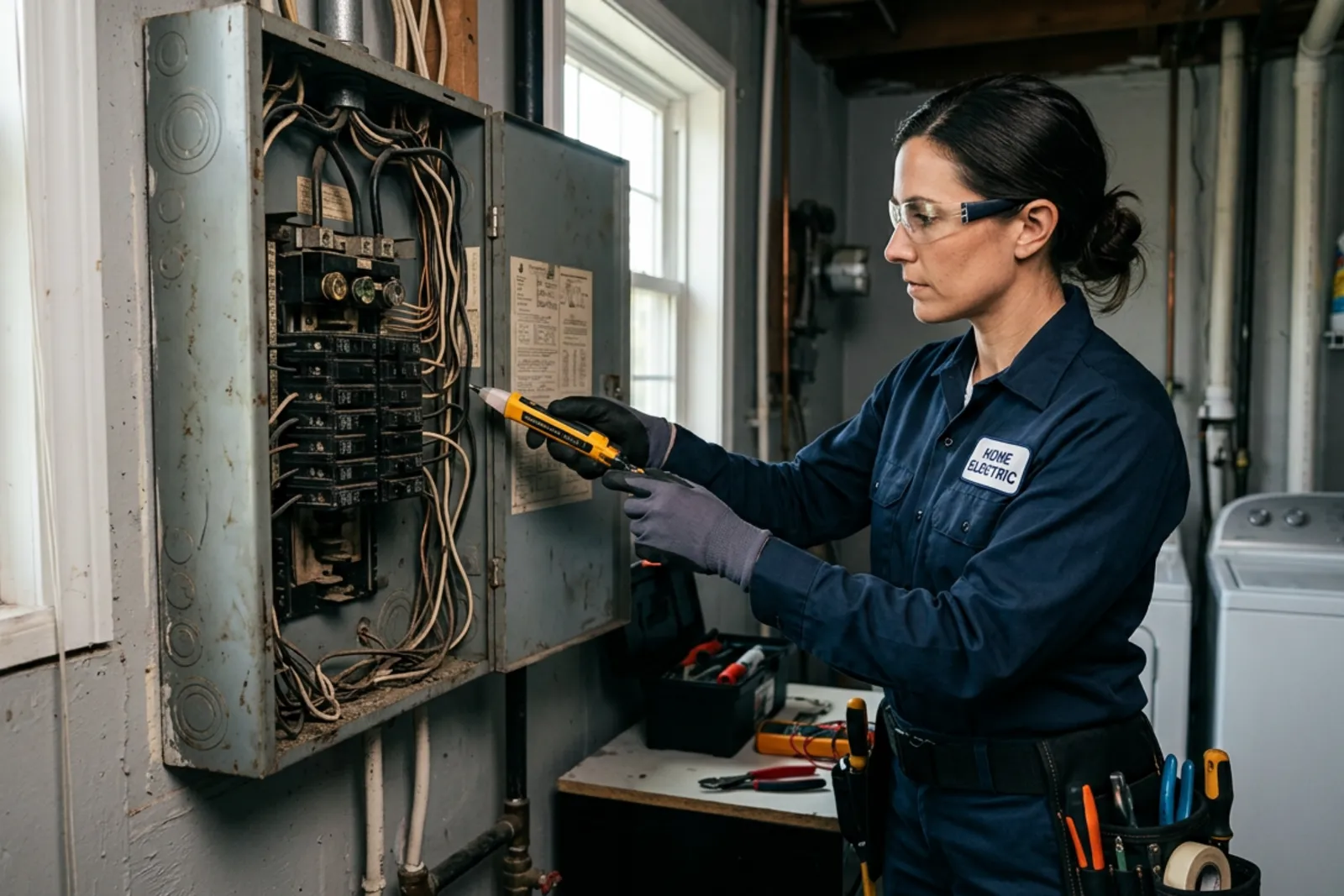
Does Your North Vancouver Home Need an Electrical Panel Upgrade?
Does your North Vancouver home need an electrical panel upgrade? Learn how safety checks, load calculations, and future plans guide the decision. Read our guide.
October 9, 2026
An older electrical panel can make a homeowner nervous, especially when the next project is an EV charger, heat pump, induction range, or basement suite. Many North Vancouver homes built between the 1950s and 1980s have 60-amp or 100-amp service. Those ratings deserve attention, but neither tells the whole story.
A full panel does not necessarily mean the home needs more electrical capacity. A 100-amp service is not automatically inadequate for a new appliance. And installing a panel labeled “200A” does not give the home 200-amp service if the conductors and other service equipment still support only 100 amps.
The right decision starts with two questions: Is the existing installation safe and in good condition? Then, can it support the loads the household uses now and plans to add? Answer those in that order. A load calculation, an inspection of the service equipment, and a clear account of future plans will tell you far more than the number printed on the main breaker.
Start With Safety, Not Capacity
If breakers trip repeatedly during ordinary household use, or if service equipment shows damage or deterioration, investigate before adding another load. Repeated trips can have several causes, including an overloaded circuit, a wiring fault, or defective equipment. Simply fitting a larger breaker is not a safe fix.
An assessment should look beyond the panel cover. A licensed electrical contractor may need to examine the service conductors, meter base, overhead mast and connections where applicable, grounding and bonding, panel condition, and accessible existing wiring. The panel’s location matters too. Equipment tucked into a finished basement or an obstructed area may be difficult to work on safely and may complicate a replacement.
Older wiring deserves its own assessment. Knob-and-tube wiring, for example, does not automatically mean every part of the service must be replaced. It may, however, affect renovation plans, insurance documentation, or the scope of work needed to install new circuits safely. Similarly, a grounding or bonding deficiency calls for correction even if the home’s calculated load is modest.
If you notice heat damage, a burning smell, or other signs of an active electrical problem, stop using the affected equipment and arrange a prompt professional assessment. Capacity planning can wait until the immediate condition is understood.
A Full Panel and an Overloaded Service Are Different Problems
Think of panel space and service capacity as separate constraints. The panel needs appropriate places for breakers. The service needs enough capacity to supply the expected electrical demand. A home can run out of breaker positions while still having capacity available, or have open breaker positions while its planned loads exceed what the service can support.
Suppose a 100-amp home needs a circuit for a workshop, but every permitted breaker position is occupied. If the load calculation shows adequate capacity, an appropriately designed subpanel may provide the needed spaces. A listed tandem breaker arrangement might be another option, but only where that specific panel is designed to accept it and its labeling and applicable requirements permit it. Breaker compatibility is not something to guess at.
Now picture a different 100-amp home with empty spaces in the panel. Its owners want a Level 2 charger, an electric heat pump, and an induction range. Open spaces do not prove that the service can carry those loads. The new circuits need a demand calculation before anyone decides how to supply them.
The reverse shortcut is also common: replacing a 100-amp panel with one rated for 200 amps and assuming the job is done. The panel is only one component. Until the service conductors, meter equipment, utility connection, and other required parts are approved for the higher rating, the home does not have 200-amp service.
Calculate the Load Before Choosing Equipment
A qualified electrical contractor can calculate the home’s electrical demand using the applicable provisions of the Canadian Electrical Code, including Rules 8-100 through 8-400. The calculation considers the existing installation and the proposed additions. It is the basis for a sound design and the permit process, rather than a rough tally of the amp ratings printed on appliance labels.
That distinction matters. Household devices do not all draw their maximum rated current at once, and code demand rules account for that in prescribed ways. At the same time, a homeowner should not assume that a new charger is harmless because the car usually charges overnight. The proposed equipment and its operating requirements still need to be accounted for correctly.
Give the electrician specifics where you can: the charger’s intended charging rate, the heat pump type, whether a hot tub or sauna is planned, and whether a future suite will add cooking or laundry equipment. Vague plans make it harder to choose an option that will still work after the next renovation.
When the existing service may be enough
If the service equipment is in good condition and the load calculation shows available capacity, the least disruptive solution may be a new circuit, a subpanel, or another targeted change. For a single EV charger installation, that can be substantially simpler than replacing the entire service.
For some 100-amp homes, an energy management system is worth considering. Properly designed equipment can monitor or coordinate selected high-demand loads so they do not overload the service. For example, an EV charger may reduce or pause charging when household demand rises. Canadian Electrical Code Rule 8-500 addresses electric vehicle energy management systems, and the design and installation must meet the applicable requirements accepted by Technical Safety BC.
Energy management is a useful option, not a repair for damaged conductors or defective meter equipment. It also requires an honest conversation about convenience. A charger that sometimes slows down may be perfectly acceptable for overnight home charging; a household with several large new loads may prefer the flexibility of a service upgrade.
When a Full Service Upgrade Makes More Sense
A 200-amp panel and service upgrade becomes more likely when a home has a 60-amp service, the calculated demand exceeds what the current service can support, or major electrical renovations will add several high-demand loads. Damaged or inadequately rated service components can also make replacement necessary.
Consider a household planning a suite, a heat pump, induction cooking, and a hot tub. Addressing each project independently could lead to repeated changes, new delays, and work that must later be removed. Reviewing the full renovation plan at the beginning gives the electrician a chance to design for the combined demand.
A 200-amp service is not a promise that every future appliance will fit without further review. It is a higher-capacity starting point. The final design still depends on the calculated load and the condition and configuration of the property.
A full upgrade involves more than a new breaker box. It may require new service conductors sized for the approved load and installation method, a suitable meter base, changes to an overhead mast or underground connection, and updates to grounding and bonding. You may see 4/0 aluminum or 2/0 copper mentioned as examples of residential 200-amp service conductors. Those are not universal specifications: material, wiring method, installation conditions, code requirements, and utility requirements determine the actual design.
Grounding and bonding must also be checked against current requirements, including the relevant Canadian Electrical Code rules such as Rule 10-700. The work may involve a grounding electrode, bonding continuity, or bonding to a water service where present. Deficiencies found during an upgrade need to be addressed as part of the approved work.
New branch circuits may require arc-fault circuit-interrupter protection, depending on their rating, purpose, location, and the applicable code edition. That does not mean every existing circuit must automatically be rebuilt whenever a panel is changed. It means new work and alterations need to be evaluated against the requirements that apply to them.
Utility Coordination Can Drive the Schedule
Main-service work generally requires a utility disconnect and reconnection. The electrical contractor also needs to coordinate the permit and inspection process. These steps should be settled before a homeowner books other trades or assumes the power will be back by dinner.
An overhead service may be relatively straightforward if the existing connection and access are suitable. A simple panel replacement with overhead service might involve roughly six to eight hours without power. That is an estimate, not a guaranteed appointment window. Work on the meter base or mast can add time.
Underground service upgrades may be more involved. Depending on the property and utility requirements, they can call for trenching, access to buried infrastructure, and multiple visits. A larger project may take one to three days or more to complete, while the actual outage depends on how the work is sequenced and when disconnection, inspection, and reconnection can occur. Utility availability is often as important to the schedule as the electrical work itself.
This is one reason to identify the service type early. If wires arrive from a pole, the home likely has an overhead service. If the supply enters through conduit near or below ground level, it may be underground. An electrician can confirm the arrangement and explain what it means for the proposed project.
Permits and Records Are Part of the Job
Service upgrades require the appropriate electrical permit and inspection through Technical Safety BC. A qualified licensed electrical contractor should also confirm utility requirements before modifying service equipment. Permits and inspections help verify that the installed conductors and equipment match the approved service capacity and that the work meets applicable requirements.
Keep the permit and inspection records with the home’s other documents. They can be useful for insurance questions, later electrical work, and a future sale. A properly documented upgrade can remove a practical concern for a buyer who wants EV charging, a heat pump, or a renovation. It is not a guaranteed increase in sale price, but clear records are better than an unexplained panel change with no paperwork.
Older homes do not become subject to every new-code requirement simply because one component is replaced. Still, new work must meet the requirements that apply to its scope. The details are best settled during design and permitting, before a surprise on inspection day changes the schedule.
What to Gather Before an Electrical Assessment
You do not need to diagnose the system yourself. A few observations will help the electrician give you a more useful assessment:
Find the main panel and meter, and note whether the electrical supply appears to be overhead or underground.
Record the main breaker rating, such as 60, 100, 125, or 200 amps. Do not remove covers to inspect equipment.
List existing and planned major loads, including EV charging, a heat pump, hot tub, sauna, induction range, suite, or addition.
Note where the panel is located and whether finished walls, storage, or other obstacles affect access.
Gather earlier permits, inspection reports, and any records of panel changes or home rewiring.
Bring the renovation timeline too. A charger planned next month and a suite planned next year should be considered together, even if the electrical work will happen in stages.
The decision then becomes manageable. Address unsafe conditions first. Calculate demand. Determine whether the constraint is breaker space, service capacity, damaged equipment, or existing wiring. Consider a subpanel or energy management where those options fit. Choose a full service upgrade when the condition of the equipment or the planned load calls for one.
For many North Vancouver homes, a 200-amp upgrade will be the sensible answer. For others, it will be more work than the situation requires. The safest choice is the one supported by the load calculation, an inspection of the whole service, and a permitted plan for what the household actually intends to use.
Need a licensed electrician?
Free consultations across Greater Vancouver — and 24/7 emergency service.
Get a Free Quote