
Outdoor Electrical Safety in Coastal BC: What’s Normal, What Isn’t, and When to Call a Pro
Learn outdoor electrical safety in coastal BC, what’s normal, what’s not, and when to call a pro. Protect your home with expert guidance from Eagle Power.
September 3, 2026
If you live in coastal BC, you get used to moisture. Wet decks, damp siding, soggy extension cords somebody forgot to bring in, all of it starts to feel ordinary. That familiarity is part of the problem.
Outdoor electrical issues often don’t look dramatic at first. A patio light flickers after rain. A GFCI outlet trips once and then resets. Holiday lights stay up through one winter, then another. Nothing catches fire, so people assume it’s fine.
Sometimes it is. Often it isn’t.
In Greater Vancouver, including North Vancouver and nearby communities, outdoor wiring takes a beating from rain, salt air, condensation, and long shoulder seasons where everything stays damp for weeks. The result is confusion. People know water and electricity are a bad mix, but they are less sure about where the real line is between “annoying” and “unsafe.”
Let’s clear that up.
Why coastal BC is harder on outdoor electrical systems
Outdoor electrical equipment anywhere has to handle weather. Coastal BC adds a few extra headaches.
The obvious one is rain, but steady moisture is only part of the story. We also deal with wind-driven water, moss growth, leaf buildup in covers, temperature swings that create condensation inside enclosures, and corrosion that creeps into terminals and connectors over time. An outlet can look okay from the front and still be deteriorating inside.
This matters for simple things like deck receptacles and path lights. It matters even more for higher-load equipment such as hot tub wiring, sauna wiring, pumps, landscape lighting transformers, and home charging equipment for an EV.
A lot of outdoor failures start small. A cracked gasket. A loose cover. A fixture rated for damp locations installed in a spot that is actually exposed to direct rain. A splice tucked somewhere it should never have been. Nobody notices until the GFCI starts tripping or a breaker goes.
That’s why outdoor electrical work in Greater Vancouver needs to be treated as its own category, not as an afterthought to indoor work.
Myth 1: Outdoor lights can stay up year-round
Sometimes yes. Often no.
Permanent exterior lighting that is listed and installed for wet locations can remain outdoors year-round. That includes many porch lights, soffit fixtures, hardwired wall lights, and some landscape lighting systems. Temporary string lights and seasonal decorative lights are a different story. Plenty of them are not meant for months of exposure to rain, UV, wind, and freezing weather.
Even when the lights themselves are rated for outdoor use, the weak points are usually the connections, plugs, clips, and mounting methods. A string of lights draped over a metal railing for one month during the holidays is one thing. Left up indefinitely, it becomes part of your electrical system whether you intended that or not.
If you want year-round exterior lighting, install a real system. That might mean hardwired fixtures, weather-rated low-voltage lighting, or a proper lighting design that matches how you actually use the yard, deck, stairs, and entrances.
The main question is simple. Was this product installed as a permanent solution, or did it slowly become one by accident?
Myth 2: A little moisture around an outlet is normal
No. Damp weather is normal. Water intrusion into an electrical box is not.
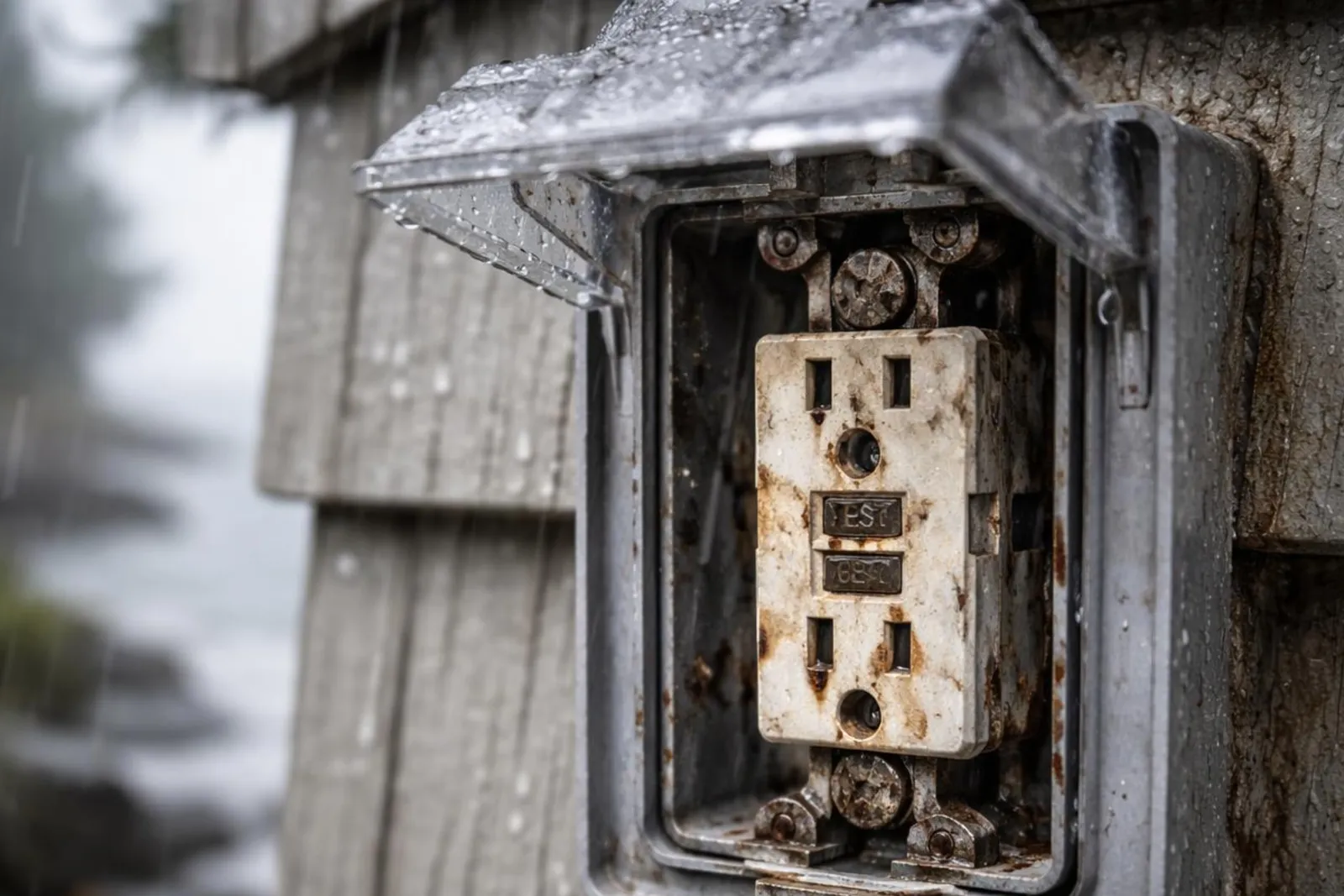
An outdoor receptacle should be protected by the right enclosure, cover, and sealing details for the location. If you open an in-use cover and see droplets, rust, staining, or obvious moisture inside the box, something is wrong. Maybe the cover is damaged. Maybe the box is mounted poorly. Maybe water is entering from the wall cavity or from the conduit. Whatever the cause, it needs attention.
People sometimes shrug this off because the outlet still works. That is not reassuring. Corrosion can progress slowly while the receptacle continues to energize. The first real symptom may be nuisance tripping, a failed device, or in bad cases, overheating at a compromised connection.
A weather-resistant receptacle and cover are not optional details in our climate. They are the bare minimum.
Myth 3: If the GFCI only trips during rain, it’s just being sensitive
A GFCI that trips is doing its job. The question is why it had to.
Ground fault protection exists because electricity can leak where it shouldn’t, including through wet surfaces and people. If an outdoor GFCI trips during or after rain, that usually points to moisture intrusion, a damaged cord, a failing fixture, a bad connection, or sometimes an issue farther downstream on the same protected circuit.
People call these “nuisance trips,” and sure, sometimes a device ages out and becomes touchy. But frequent tripping is not something to normalize. It is information.
Here’s a practical way to respond:
Unplug everything on the affected outdoor circuit.
Reset the GFCI once.
If it holds, plug items back in one at a time.
If it trips with nothing plugged in, the problem is likely in the receptacle, wiring, cover, fixture, or another connected device on that circuit.
If it trips again after rain, stop using that receptacle until it has been checked.
That is a repair call, not a wait-and-see situation. Outdoor electrical repairs are usually cheaper and simpler before corrosion spreads or a hidden splice fails completely.
Myth 4: An outdoor extension cord is fine as a long-term solution
This is one of those habits that starts as convenience and ends as infrastructure.
Outdoor-rated extension cords have legitimate short-term uses. Running a cord across the yard every weekend to power a pond pump, heat tape, patio lighting, or a freezer in a shed is a sign you need a permanent receptacle or circuit. Extension cords are more vulnerable to water entry, physical damage, UV breakdown, pinched insulation, and loose plug connections. They also invite daisy-chaining and overloading.
The same logic applies to detached offices, workshops, and covered patios. If the space has become part of daily life, give it proper power.
That often falls under residential electrical services, and sometimes electrical renovations if the area is being updated anyway. In commercial settings, outdoor patios, signage, parking areas, and seasonal displays bring similar risks, which is why commercial electrical services often include regular outdoor maintenance and inspections.
Myth 5: Small outdoor upgrades don’t really need permits
Some repairs are straightforward. Some upgrades are not.
Replacing a failed weather-rated receptacle with the same type may be one thing. Adding a new circuit to the yard, running power to a shed, installing a hot tub, setting up a sauna electrician for sauna wiring, or putting in EV charger installation for home charging is different. These jobs often need permits and a permitted inspection because they involve new wiring, load calculations, bonding, grounding, equipment clearances, or panel capacity.
People get tripped up here because the equipment sits outside and looks self-contained. A hot tub is still a serious electrical installation. So is a Level 2 charger. So is a new heater for a backyard sauna. If you are changing load, adding circuits, trenching conductors, or modifying the service, you are well beyond casual DIY territory.
Code compliant work is not busywork. It is how you reduce shock risk, moisture failure, and expensive do-overs.
What safe outdoor electrical actually looks like
A safe setup does not need to be fancy. It needs to be appropriate for the location and use.
That usually means receptacles with proper weather-resistant devices and covers, GFCI protection where required, fixtures listed for wet or damp locations as appropriate, secure mounting, intact gaskets, sealed entries, and wiring methods meant for outdoor exposure. It also means circuits sized for the actual load, not for wishful thinking.
For homeowners, the weak spots I see most often are older deck outlets, lights mounted on aging siding, detached sheds fed by improvised wiring, and receptacles that have been painted over or cracked. For businesses, it is often exterior signage circuits, parking lot connections, patio heaters, and service areas where equipment gets sprayed, bumped, or left exposed.
Good maintenance matters too. Outdoor electrical systems are not install-once-and-forget-it systems in this climate. Periodic maintenance is a safety issue, especially around marinas, exposed hillsides, tree-covered lots, and homes close to the water.
When a repair becomes an upgrade
This is where people sometimes get annoyed, and honestly, I get it. You call for a tripping outlet and hear that the conversation may also involve panel upgrades, service upgrades, or even home rewiring in part of the property. That can feel like overkill.
Sometimes it is. Sometimes it absolutely isn’t.
If an electrician opens an outdoor box and finds overheated conductors, no grounding path, deteriorated aluminum-to-copper connections, overloaded circuits, or an old panel with no room for the equipment you want to add, then the problem is larger than the outlet that got your attention.
A few common examples:
A new hot tub electrician may discover the panel cannot support the added load safely.
A sauna electrician may find the planned circuit routing exposes wiring to conditions it was never meant to handle.
An EV charger installation for a Level 2 charger may require panel upgrades before the charger itself can be installed.
Electrical renovations on a deck or backyard suite may reveal that the existing exterior receptacles were added years ago without proper protection.
That does not mean every outdoor issue turns into a major project. It means the outdoor symptom can be the first visible sign of an indoor capacity or wiring problem.
Outdoor projects that usually deserve extra caution
Some jobs deserve immediate respect because the risk is higher and the installation details matter more.
Hot tub wiring is near the top of the list. Water, people in bare feet, metal components, heaters, pumps, and outdoor exposure all come together in one place. The same goes for sauna wiring, especially if the equipment is outdoors or in a damp accessory building.
EV charging is another big one. A Level 2 charger pulls far more power than a trickle charger plugged into a regular receptacle. For reliable home charging, the circuit, breaker, cable path, mounting location, weather exposure, and panel capacity all have to make sense together. A sloppy installation might work for a while. That is not the same as safe.
Exterior renovation work also deserves attention. If you are redoing a deck, adding a covered patio, finishing a backyard office, or planning a new lighting design, now is the time to deal with electrical properly. It is much easier to add the right outdoor circuits before surfaces are closed up.
How to choose the right help
If you need electrical work Greater Vancouver homeowners commonly face outdoors, ask specific questions. Vague reassurance is not enough.
Look for licensed electricians and insured electricians who routinely handle exterior conditions, repairs, and upgrades in wet climates. If a project involves permit work, confirm who is responsible for the permit and the permitted inspection. If you are comparing quotes for a Vancouver electrician, North Vancouver contractor, or work elsewhere in Greater Vancouver, ask whether the scope includes replacing weather-damaged boxes, upgrading covers, checking upstream GFCI protection, and verifying panel capacity.
For bigger jobs, it is reasonable to ask whether the company has a Master Electrician or FSR Contractor responsible for the work. Titles do not guarantee quality on their own, but they do tell you something about accountability and qualifications.
If the issue is urgent, a sparking outlet, a burning smell, a dead exterior circuit affecting safety lighting, water entering an energized box, then this is where emergency electrical service or 24/7 emergency service makes sense. Turn off the affected circuit if you can do so safely, keep people away from the area, and do not keep resetting a device that is tripping for a reason.
A simple rule for wet-weather electrical problems
If outdoor electrical equipment looks wet inside, smells hot, trips repeatedly, or only works in dry weather, treat that as a fault.
Not as a quirk. Not as one of those house things. A fault.
Most outdoor electrical hazards do not announce themselves with drama. They show up as inconsistency. The light that flickers after rain. The receptacle that works only if the cord sits just right. The GFCI you reset twice a month. The charger you unplug during storms because it feels safer.
That instinct is worth listening to.
In coastal BC, caution around outdoor electricity is not overreacting. It is just realistic. And if a repair turns out to need more than a quick fix, whether that means electrical repairs, service upgrades, or a code compliant installation for a new outdoor project, that is still better than finding out the hard way in the middle of the next rainstorm.
Need a licensed electrician?
Free consultations across Greater Vancouver — and 24/7 emergency service.
Get a Free Quote