
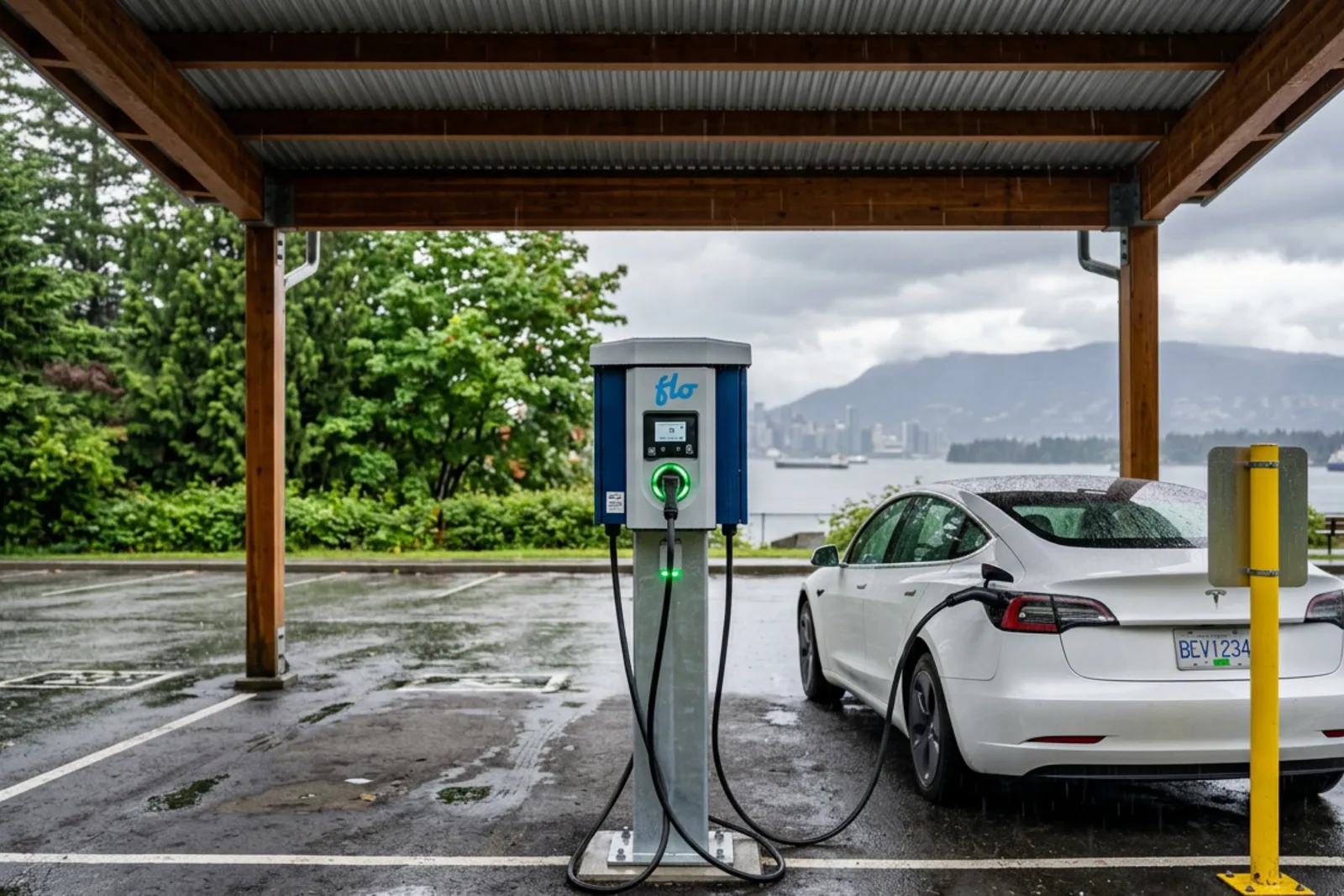
Is an Outdoor EV Charger Ready for North Vancouver Weather?
Learn how to choose an outdoor EV charger for North Vancouver's wet coastal weather. Plan a safe, reliable installation today.
September 25, 2026
A Level 2 charger can make home charging much easier. Plug in after work, wake up with a useful amount of range, and skip regular stops at public stations. For many drivers in North Vancouver and across Greater Vancouver, that convenience is reason enough to consider an outdoor installation.
But “outdoor capable” is not a complete answer.
A charger may be pictured on an exterior wall and described as durable, yet those broad claims do not tell you how its enclosure handles wind-driven rain, whether its cable remains flexible in cold weather, or how its hardware holds up near salt air. In a wet coastal climate, those details matter. They affect safety, reliability, maintenance, and the life of the equipment.
Before planning an EV charger installation, it helps to know which questions to ask, what documentation to look for, and where the installation site itself can create problems.
Why coastal weather changes the conversation
North Vancouver gets frequent rainfall, wet winters, changing temperatures, and long stretches of damp conditions. Some properties also have exposure to coastal air, especially in more open locations. Road spray and deicing materials can add another source of corrosion near driveways and garages.
An outdoor charging station has to deal with more than falling rain. It may face water that is blown sideways by wind, splashback from the ground, moisture collecting behind equipment, UV exposure during summer, dirt on the connector, and repeated handling with wet gloves.
A charging unit can be perfectly appropriate for ordinary outdoor use while still needing sensible site protection. That distinction gets lost when people see an exterior installation photo and assume every wall location is equally suitable.
The safest approach is to treat the charger, cable, connector, mounting surface, electrical circuit, and drainage around the parking spot as one system. If one part is poorly planned, the rest of the setup has to work harder.
What a product listing can, and cannot, prove
A residential Level 2 charger listing may describe high charging power, smart controls, and durability. It may show a black J1772 unit mounted outdoors. Those details suggest the product is intended for home charging and may be designed for exterior applications.
They do not, on their own, confirm performance under every outdoor condition.
For example, a retail listing without a published enclosure rating does not tell you how the unit resists water intrusion. Without an operating-temperature range, you do not know the conditions under which the manufacturer expects it to charge normally. Without details about cable construction, seals, fasteners, coatings, and connector storage, it is hard to judge long-term use in a damp or salty environment.
This is not a reason to dismiss a charger. It is a reason to pause before making a site-specific claim such as, “This is the best choice for an exposed coastal driveway.”
A customer review can also be useful for understanding delivery, ease of use, or first impressions. It is much weaker evidence for long-term corrosion resistance or performance after several winters of heavy rain. Those questions need manufacturer documentation and a careful look at the home.
The specifications worth checking before you buy
If you are comparing outdoor chargers, ask for the product manual and technical data sheet rather than relying only on the sales page. A reputable product should have clear installation instructions and electrical ratings.
Here are the areas that deserve attention.
Enclosure and water-ingress rating
Look for a stated NEMA or IP rating. These ratings describe the level of protection an enclosure provides against environmental conditions such as dust and water. The exact rating needed depends on the installation location and local electrical requirements, so it is not wise to choose based on a number alone.
Still, the absence of a rating is a problem for an exposed installation. You need to know whether the manufacturer approves the unit for outdoor mounting and what kind of water exposure it is built to handle.
A charger under a deep eave on a sheltered side wall has a different risk profile than one mounted beside an open driveway where rain regularly blows across the house.
Temperature limits
Electric vehicle chargers contain electronics, cables, seals, and connectors that all react differently to heat and cold. Ask for both operating and storage temperature ranges.
In the Lower Mainland, extreme cold may be less common than in interior British Columbia, but temperature swings still happen. A cable that becomes stiff in cold conditions is harder to manage safely. Heat also matters when a charger receives direct afternoon sun or is installed on a dark wall with limited airflow.
Temperature specifications tell you what the equipment is designed to tolerate. They should not be guessed from the charger’s appearance.
Cable and connector protection
The cable gets more physical abuse than the wall-mounted charger. It is pulled, coiled, stepped around, exposed to puddles, and occasionally left in an awkward position after a rushed morning.
Check whether the manufacturer provides guidance on:
Outdoor cable use and temperature flexibility
Proper connector storage when charging is not in progress
Use of a holster or dock to keep the plug off the ground
Inspection of the cable jacket for cuts, flattening, or cracking
Restrictions on extension cords or adapters
A connector should never sit in a puddle, hang where it can be hit by a vehicle, or rest on the driveway where grit can enter the contact area. A holster is a small detail, but it often makes the setup cleaner and safer.
Corrosion resistance
For homes near the coast, ask directly about corrosion resistance. The useful questions are specific: What materials are used for outdoor fasteners? Are mounting components coated? What protection does the enclosure have against corrosion? Is there manufacturer guidance for salt-air environments?
Some installers see corrosion first at the hardware and mounting points, not necessarily inside the charger. Rusting screws, damaged brackets, and dissimilar metals can create maintenance headaches long before the electronics fail.
If the documentation does not address salt air, do not assume the charger is unsuitable. But do not assume it is optimized for coastal exposure either. Place it more carefully, inspect it more often, and get written clarification from the manufacturer if the location is especially exposed.
Choosing the right location on your property
The charger’s location can matter as much as its published rating. A good site reduces water exposure and makes the charging routine simple. A bad site invites damage, strained cables, and repeated little annoyances that eventually become safety concerns.
An exterior wall near the parking space often works well when it has some overhead protection, a solid mounting surface, and enough room to route the cable without crossing a walkway. The charger should be close enough to the vehicle’s charge port that the cable reaches comfortably, with slack to spare but no need to stretch or loop excess cable across the ground.
Avoid locations where water collects. This includes low points beside downspouts, the base of poorly graded walls, and spots where melting snow or driveway runoff forms puddles. Water can enter through cable penetrations or collect around the lower portion of the equipment even if rain does not fall directly on it.
It is also worth thinking about vehicle movement. A charger on the front edge of a garage wall may be easy to reach, but it is exposed to door swings, bumpers, bicycles, snow shovels, and lawn equipment. A modest protective barrier or better placement can prevent expensive damage.
For shared parking areas, the planning gets more involved. Cable paths, access, visibility, building rules, and who is responsible for maintenance all need to be clear. Commercial electrical services and strata projects may have different design requirements than a detached home.
Outdoor installation needs more than a weatherproof box
A proper Level 2 charger installation starts with the home’s electrical capacity. Level 2 charging uses 240 volts and often adds a substantial continuous load to the electrical system. The charger’s maximum output is only one part of the calculation. The service size, panel capacity, existing loads, circuit requirements, wiring route, and local code rules all have to be reviewed.
That is why a charger should not be selected first and evaluated later. In some homes, panel upgrades or service upgrades may be needed before a higher-power charger can be installed safely. In others, load management equipment or a lower charging setting may make more sense.
A qualified professional should also assess the route from the electrical panel to the charger. Exterior runs may require conduit, weather-rated fittings, and careful sealing where wiring passes through the building envelope. A sloppy penetration can allow moisture into the wall, even if the charger itself is well made.
Permits and inspections are part of this process. A permitted inspection checks that the installation meets applicable electrical requirements, including circuit protection, conductor sizing, grounding, mounting, and disconnecting provisions where required. It may feel like an extra step, but it is one of the clearest ways to make sure the work is code compliant.
For this work, hire licensed electricians who have experience with EV charging equipment. Ask whether they are insured electricians, whether they will obtain the required permit, and whether the quoted work includes a load calculation. Those are practical questions, not paperwork for its own sake.
A quick site assessment before calling an electrician
You do not need to diagnose your electrical system yourself, but a few observations can make the consultation more useful.
Take note of where the vehicle parks and which side the charge port is on. Think about where the cable would hang when the car is connected. Look for downspouts, roof runoff, standing water, and exposed walls that receive wind-driven rain. If the charger will be outdoors, take photos after a heavy storm. That often reveals drainage patterns that are invisible on a dry day.
Also note your electrical panel’s location and rating if it is visible on the main breaker. If you are planning other electrical work, such as a kitchen renovation, home rewiring, hot tub wiring, sauna wiring, or a heat pump installation, mention it. Electrical renovations can change the load calculation, and it is better to plan connected projects together.
For older homes in North Vancouver, a charger inquiry sometimes becomes a broader discussion about panel capacity, aging wiring, or needed electrical repairs. That is not always welcome news, but it is better than discovering an overloaded panel after equipment has already been purchased.
Maintenance for a charger exposed to rain and coastal air
Outdoor charging equipment is fairly low maintenance, but “low” does not mean “none.” A short inspection every few months is sensible, especially after winter storms.
Check that the charger is firmly attached to the wall and that the cable has no cuts, crushing, unusual stiffness, or exposed inner material. Look at the connector face for dirt, moisture, corrosion, or damaged pins. Keep the connector in its holster when it is not in use. If the manufacturer allows cleaning, follow its instructions and avoid spraying the unit directly with a pressure washer.
Pay attention to rust streaks around screws or brackets, deteriorated caulking around cable entries, and recurring standing water near the wall. These issues are often easier to correct early. If the charger trips breakers, shows repeated fault messages, gets unusually hot, or has visible damage, stop using it and arrange an inspection.
Do not open the unit or attempt electrical repairs unless you are qualified to do so. Charging equipment carries significant electrical load, and water exposure raises the stakes.
Questions to ask before approving an outdoor charger
Before buying a particular model, ask the manufacturer or seller for written answers to these questions:
Is this exact model approved for outdoor installation?
What NEMA or IP enclosure rating does it have?
What are its operating and storage temperature limits?
Are there instructions for exposed walls, eaves, garages, and outdoor parking spaces?
What protection is recommended for the connector and cable?
Does the manufacturer provide guidance for coastal or salt-air conditions?
What mounting clearances and drainage conditions are required?
Which local permits and inspections are needed for installation?
A clear technical manual is reassuring. Vague phrases such as “enhanced durability” are not enough when the charger will spend years outside in a wet climate.
The practical takeaway
An outdoor Level 2 charger can be a safe, convenient choice for home charging in North Vancouver. The charger does not need to be hidden indoors to work well. But it should be selected using documented environmental ratings, installed in a location that limits unnecessary exposure, and connected through a properly designed electrical circuit.
A retail page that shows outdoor use can be a helpful starting point. It is not the final word on rain, snow, salt air, corrosion, or mounting conditions. Read the manufacturer’s technical documents, consider the actual weather patterns around your home, and have a qualified Vancouver electrician assess the electrical side before purchasing.
That bit of preparation is less exciting than unboxing a new charger. It is also what makes the installation safer, cleaner, and more likely to keep working when the rain has been coming down for a week.
Need a licensed electrician?
Free consultations across Greater Vancouver — and 24/7 emergency service.
Get a Free Quote