
Vancouver Electrical Panel Upgrade Costs in 2026: What Homeowners Should Budget For
Learn Vancouver electrical panel upgrade costs for 2026, including 100-amp to 200-amp service upgrades. Budget confidently—contact Eagle Power.
October 2, 2026
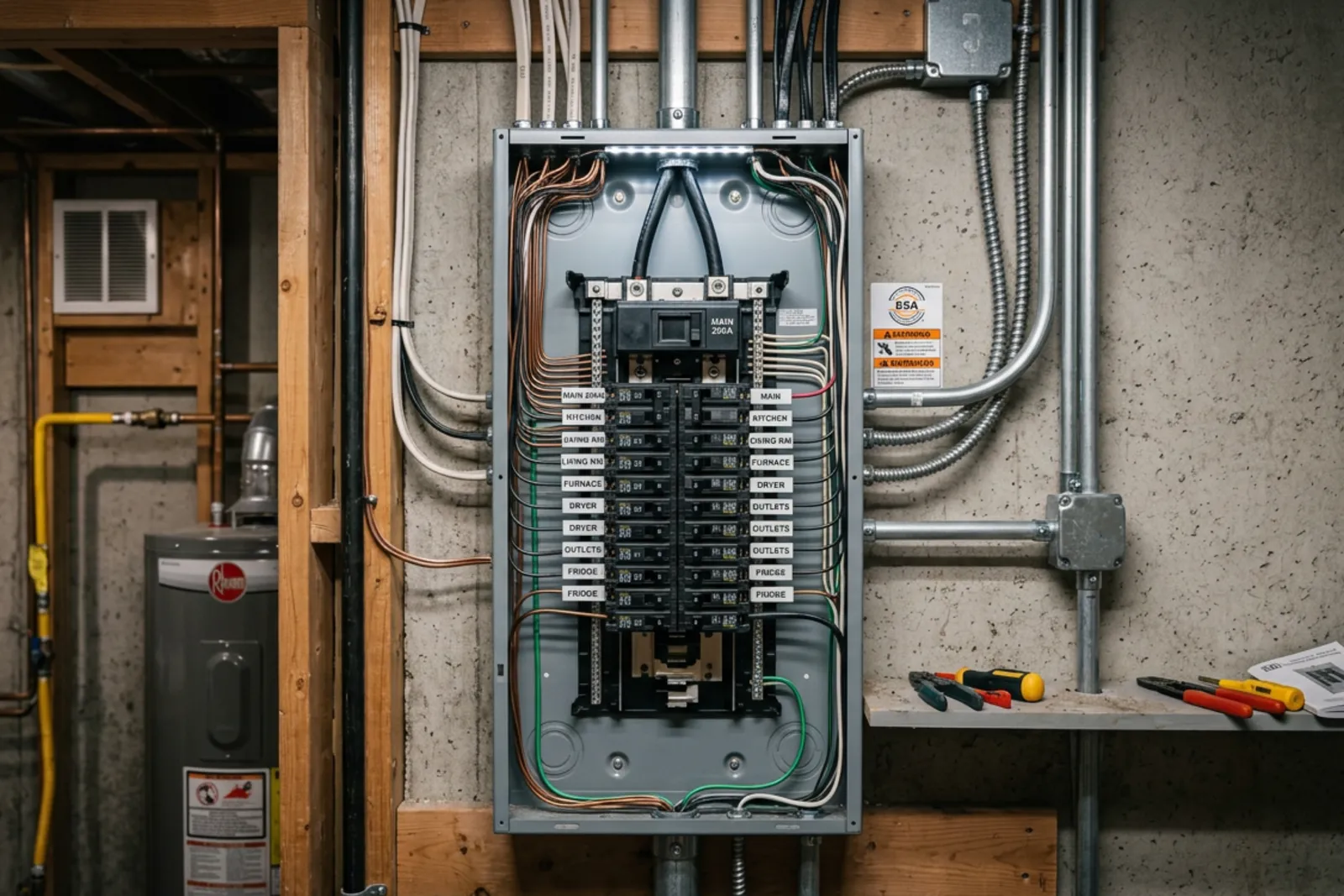
Electrical panel upgrades are easy to misunderstand because the phrase can describe two very different jobs. One homeowner may need a new 200-amp panel in the same location, while another needs a full increase from 100-amp service to 200 amps, including changes to the meter base, service entrance, utility connection, and grounding system.
Those projects have very different costs.
For homeowners in Vancouver and Greater Vancouver, understanding that distinction is the first step toward getting a useful quote and avoiding surprises once work begins. A panel may look like one metal box on a wall, but it connects to the entire electrical system of the property. The age of the home, condition of the wiring, planned appliances, and distance to new loads all matter.
This guide explains typical 2026 cost ranges, why quotes vary, and when a service upgrade makes practical sense.
Typical Electrician Rates in Vancouver and Greater Vancouver
Licensed electricians in Vancouver and the Lower Mainland commonly charge about $100 to $130 per hour. A service call often costs between $160 and $260, which generally covers travel, attendance, and initial diagnosis.
That initial visit matters more than people may expect. A qualified electrician needs to inspect the existing panel, confirm the service size, assess available breaker space, and look for issues that may affect safety or code compliance. Photos can help begin a conversation, but they rarely tell the full story. The meter base may be outdoors, wiring may disappear into finished walls, and prior electrical work may not be visible at all.
A site assessment is especially important in older Vancouver homes, including many properties in North Vancouver. Homes that have been renovated in stages can have a mix of older and newer wiring methods, panels, breakers, and grounding arrangements. What looks like a simple panel replacement may uncover equipment that no longer meets current requirements.
For any project involving panel upgrades, home rewiring, or new high-demand equipment, ask whether the estimate includes permits, inspection, labor, materials, utility coordination, and potential drywall or finish repairs. A low quote that excludes these items is not necessarily a lower total project cost.
The Difference Between a Panel Replacement and a Service Upgrade
The words “200-amp upgrade” get used loosely. That can create confusion when homeowners compare estimates.
A new panel rated for 200 amps does not automatically mean the home has 200-amp electrical service. The incoming service equipment must also be rated and configured to supply that capacity safely.
Straightforward 200-Amp Panel Upgrade: About $4,200 to $6,000
A typical 200-amp panel upgrade in Vancouver may cost approximately $4,200 to $6,000. This range generally applies where the existing service can already support the intended electrical load, and the primary work involves replacing or modernizing the distribution panel.
The scope may include installing a new panel, replacing breakers as needed, labeling circuits, improving grounding and bonding, and bringing portions of the installation into compliance with current electrical rules.
This type of project can make sense when an existing panel is crowded, outdated, damaged, or no longer suitable for additional circuits. It may also be part of electrical renovations where a homeowner needs space for a kitchen circuit, lighting design changes, bathroom upgrades, hot tub wiring, sauna wiring, or dedicated circuits for appliances.
Still, a larger panel does not solve a capacity problem if the incoming service remains limited. Think of it like replacing a hallway with a wider doorway while the road leading to the building stays the same size. The new doorway may provide more room for circuits, but it does not necessarily increase how much power the property receives.
Full 100-Amp to 200-Amp Service Upgrade: About $9,000 to $12,000
A complete 100-amp to 200-amp service change usually costs more, often in the range of $9,000 to $12,000. This is a broader project because it may include much more than the panel itself.
Depending on the home, the work can involve:
A new 200-amp panel and breakers
Meter base replacement or modification
New service entrance conductors
Grounding and bonding upgrades
Changes to the connection between the utility supply and the home
Permit applications, inspection, and BC Hydro coordination
Load calculations for current and planned electrical demand
The final amount depends heavily on site conditions. A home with accessible service equipment and a straightforward wiring route may fall near the lower end of the range. A property with aging infrastructure, difficult access, finished walls, or equipment that needs replacement can cost more.
This distinction is worth repeating because it is where many quote comparisons go wrong. If one quote is for replacing an interior panel and another is for increasing the entire property’s service capacity, they are not competing prices for the same job.
Why Electrical Panel Upgrade Quotes Vary
A reliable quote should explain what the electrician found, what needs to be replaced, and why. If an estimate simply says “200-amp upgrade” without clarifying the service scope, ask more questions.
Legacy Wiring Can Change Everything
Older homes may still contain knob-and-tube wiring, an early wiring method common in some properties built before the mid-20th century. Its presence does not always mean the entire home must be rewired immediately, but it often creates a more complicated situation.
Many insurers are reluctant to insure homes with active knob-and-tube wiring. The system may lack a grounding conductor, may have been altered improperly over the decades, or may be hidden behind walls and ceilings where its condition is hard to verify.
A panel replacement does not automatically correct old branch wiring. If a licensed electrician discovers knob-and-tube, deteriorated insulation, unsafe splices, aluminum branch wiring concerns, or ungrounded circuits, the scope may expand into partial or full home rewiring.
This is one reason a detailed inspection is better than a quick price over the phone. The electrician is not trying to make the project complicated. They are trying to avoid discovering a safety issue after the work is already underway.
The Meter Base and Service Entrance Matter
The panel is only part of the electrical system. For a real service-capacity increase, the meter base, service entrance conductors, grounding equipment, and related components must be suitable for the new rating.
If the meter base is undersized, corroded, damaged, or incompatible with the planned upgrade, it may need replacement. If the service entrance route needs new conduit or larger conductors, labor and materials increase. These items can account for a meaningful share of a full service upgrade cost.
Utility coordination may also be required. BC Hydro scheduling, meter work, and connection requirements can affect the timeline. This is different from a basic electrical repair or interior panel replacement where the service rating remains unchanged.
Breaker Count and New Circuits Affect Panel Size
A household’s electrical load is not just about how many devices are plugged in. Large fixed appliances and dedicated circuits shape the calculation.
A modern home may need separate circuits for kitchen appliances, laundry equipment, bathroom receptacles, smoke and carbon monoxide alarms, heat pumps, electric baseboard heating, workshop equipment, and outdoor loads. A secondary suite can add many more circuit requirements.
A panel needs enough capacity and physical space for those breakers. It also needs to meet current rules for protective devices where required. This may include ground-fault and arc-fault protection in certain locations.
The electrician should conduct a load calculation rather than make assumptions based on the panel’s appearance. A panel can have open breaker spaces and still lack sufficient service capacity for another major load.
Long Circuit Runs Can Cost More Than the Equipment
The distance between the panel and the new equipment often drives the price of an electrical installation.
This is particularly true for EV charger installation. The charging unit itself may be fairly straightforward, but the circuit may need to travel from a basement utility room to a detached garage, a carport, a parking stall, or the far side of a townhouse. Routing cable through a finished home can require fishing through walls, ceilings, crawl spaces, or attic areas. Access is often the expensive part.
The same issue applies to hot tub electrician work, sauna electrician projects, outbuildings, heat pumps, and exterior lighting. A short, accessible run can be relatively simple. A long route through finished construction is not.
EV Charger Installation and Electrical Capacity
Home charging has become one of the most common reasons homeowners start asking about panel upgrades. A Level 2 charger can charge an electric vehicle much faster than a standard household outlet, but it requires a dedicated 240-volt circuit and enough available electrical capacity.
In Vancouver, a typical EV charger installation may cost about $1,600 to $2,900. That estimate can change sharply based on the location of the panel, parking arrangement, wire length, charger amperage, and condition of the existing service.
Two similar homes can receive very different estimates. One may have a panel in an attached garage with the vehicle parked a few feet away. The other may have a basement panel and a driveway on the opposite side of a finished house. The charger hardware may be identical, but the labor is not.
Before proceeding with home charging, ask for a load calculation. The electrician should consider existing demand, including heating, cooking, laundry, hot tubs, suites, and planned renovations. Installing a Level 2 charger without checking capacity is not a good shortcut.
In some situations, load-management equipment may help a home add EV charging without an immediate full service upgrade. In others, the existing 100-amp service simply cannot support the combined load comfortably. The right answer depends on the house, not on a generic rule.
Some utility incentives may be available for qualifying charger installations, including rebates up to $350 in certain cases. Eligibility requirements change, so confirm the current program details before building a rebate into the budget.
When a 200-Amp Upgrade Makes Sense
A 200-amp service upgrade is often practical when several electrification projects are planned together. A homeowner who expects to add a heat pump, electric range, EV charger, secondary suite, and upgraded kitchen circuits may save money by coordinating the work rather than paying for several separate mobilizations and partial upgrades.
It may also be a sensible choice during major electrical renovations. Once walls are open, it is easier to replace aging wiring, add circuits, improve grounding, and prepare for future equipment. Waiting until finishes are complete can make the same work more disruptive and labor-intensive.
On the other hand, a service upgrade is not automatically necessary just because a home is older or because a neighbor upgraded theirs. If the property has modest electrical demand, no planned electric heating or charging, and a service that passes a proper load calculation, an immediate increase may not be needed.
There is no prize for buying capacity that will sit unused for decades. The better goal is a safe system that meets current needs and leaves reasonable room for the plans you actually have.
Permits and Inspections Are Part of the Job
Most electrical work beyond simple fixture replacement requires a permit. For panel upgrades, service upgrades, EV charger installation, and substantial residential electrical services, permits and inspections should be expected rather than treated as an optional extra.
The work may be inspected by the applicable municipality or Technical Safety BC, depending on the location and project type. A permitted inspection creates a record that the work was reviewed for safety and code compliance.
Skipping the permit can create trouble later. During a sale, a buyer’s home inspector may notice unpermitted panel changes, questionable wiring, or missing documentation. Insurers may also raise concerns after a claim if electrical work was not completed properly.
For homeowners, permits are not glamorous. They can add cost and scheduling time. But electrical work is one place where paperwork has real value. You want the system tested, inspected, and documented, especially when it involves the service feeding the entire house.
How to Compare Electrical Quotes With Confidence
When reviewing estimates from licensed electricians, look beyond the final number. A clear quote should identify whether the project is a panel replacement, a service-capacity increase, or both.
It should also address the existing service size, panel condition, meter base, service entrance equipment, grounding, permit fees, inspection requirements, and any expected BC Hydro coordination. If you are planning an EV charger, heat pump, electric range, suite, hot tub, sauna, or major renovation, those loads should be included in the calculation.
Ask whether the price includes new breakers, circuit labeling, removal of old equipment, permit handling, and corrections needed for code-compliant installation. Confirm whether the contractor is licensed, insured, and authorized to perform the specific work proposed. For complex projects, a Master Electrician or appropriately qualified electrical contractor can provide an important level of oversight.
The most useful quote is not necessarily the cheapest one. It is the one that accurately describes the work your home needs.
Budget for the System, Not Just the Panel
For 2026 planning purposes, Vancouver homeowners can use roughly $4,200 to $6,000 as a starting range for a straightforward 200-amp panel upgrade, and about $9,000 to $12,000 for a full 100-amp to 200-amp service change.
Those figures are useful for early budgeting, but they are not substitutes for an on-site assessment. Older wiring, meter equipment, long circuit routes, planned electrical loads, permit needs, and utility coordination can all change the scope.
Electrical upgrades are most successful when they are planned around how a household will actually use power over the next several years. Whether the goal is safer wiring, home charging, a suite, a heat pump, or more room for future circuits, a careful assessment helps ensure the work is safe, permitted, and built for the way the home will operate.
Need a licensed electrician?
Free consultations across Greater Vancouver — and 24/7 emergency service.
Get a Free Quote