
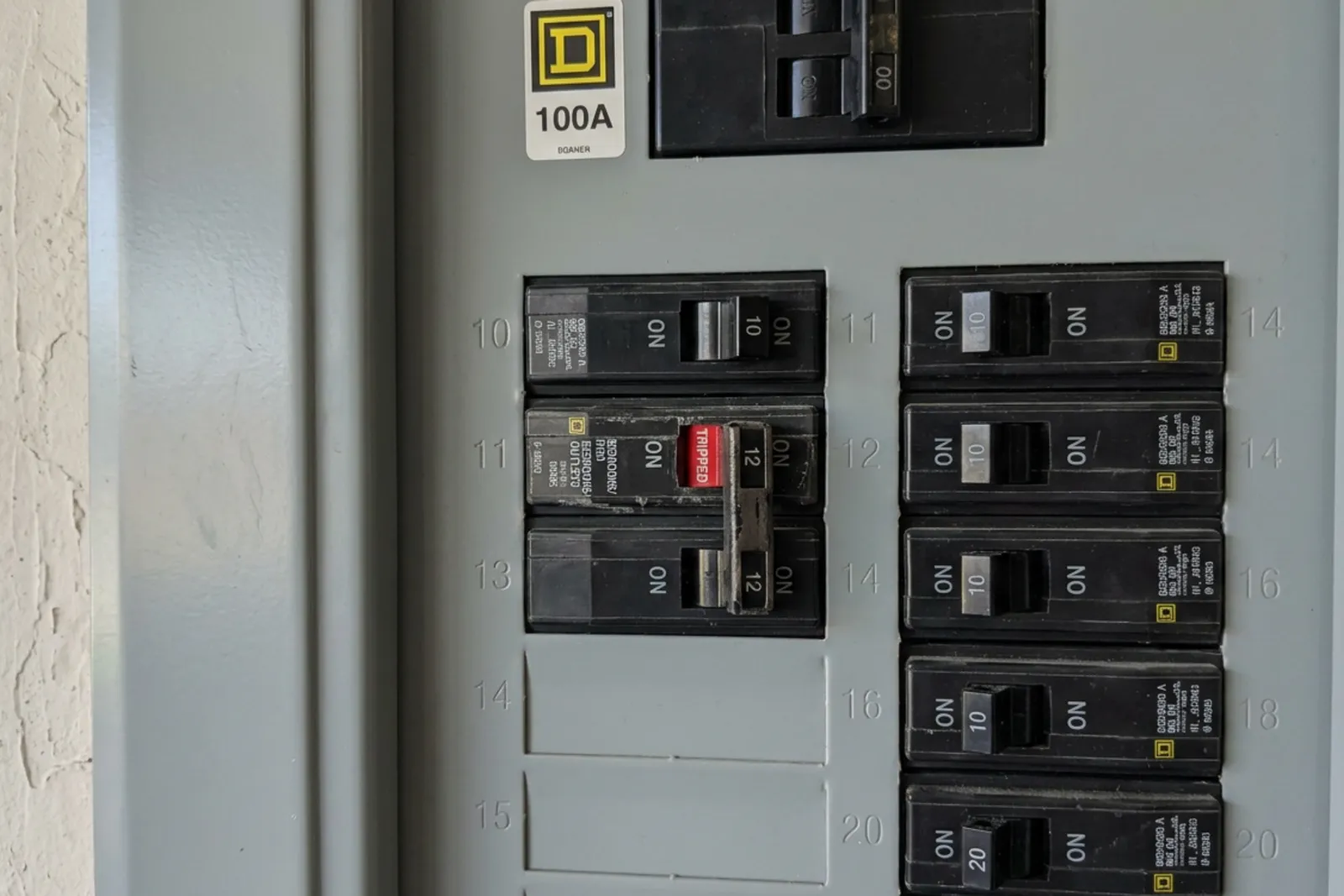
Why Breakers Keep Tripping and What to Do About It
Learn why breakers keep tripping, what warning signs to watch for, and when to call a licensed electrician. Get practical tips for handling repeated trips safely.
October 14, 2026
A breaker trips to stop the flow of electricity when it detects a condition it is designed to protect against. That interruption can be inconvenient, especially when it shuts down a kitchen appliance or leaves several rooms without power. But the breaker may be doing exactly what it should.
Repeated trips deserve attention. Resetting the breaker restores power only if it stays on; it does not fix overloaded wiring, a damaged appliance, or a loose connection.
The timing of a trip can provide useful clues. So can the equipment running at the time, the area that loses power, and any unusual smells or sounds. Here is how to recognize those clues, make safe observations, and know when professional electrical repairs are needed.
What a Tripped Breaker Is Telling You
Standard circuit breakers protect circuits against excessive current. Too much current can heat wiring beyond safe limits, so the breaker interrupts power before that condition continues.
Some breakers also have ground-fault or arc-fault protection. These detect particular electrical faults that a standard breaker may not recognize in the same way. The type of protection matters during diagnosis.
Several problems can cause a trip.
An overloaded circuit
An overload happens when the devices on a circuit draw more current than it can safely carry. A portable heater and a hair dryer running together are a familiar example. Both may work properly on their own, but their combined demand can overload a shared circuit.
The number of outlets is not a reliable guide to capacity. Outlets in different rooms may share one circuit, while neighboring outlets may be supplied by separate circuits.
A short circuit or ground fault
A short circuit occurs when electricity takes an unintended, low-resistance path, such as contact between an energized conductor and a neutral conductor. The resulting current can be very high.
A ground fault occurs when current takes an unintended path to ground, potentially through a metal enclosure or a person. Damaged insulation, moisture, and equipment defects can cause these faults.
Neither problem is something to investigate by touching wiring or opening electrical equipment.
A faulty device, damaged wiring, or loose connection
A defective appliance, damaged cord, or failing electrical component can cause a breaker to trip. Loose connections can overheat or arc, and damaged wiring can create intermittent faults.
One important limitation: a hazardous connection does not always trip a standard breaker. A circuit that remains on is not necessarily safe if there is buzzing, heat, or a burning odor.
Breakers themselves can fail, too. However, replacing the breaker without checking the circuit risks leaving the actual problem unresolved.
What the Timing of the Trip Can Reveal
Timing helps narrow the investigation, but it cannot confirm a diagnosis by itself. Different faults can produce similar symptoms.
The breaker trips immediately
A breaker that trips as soon as it is reset may be responding to a persistent short circuit, ground fault, damaged wiring, or a connected device with an active fault.
Do not hold the handle in the on position or keep trying to reset it. Leave the affected circuit off and arrange professional diagnosis.
An apparently unresponsive breaker can also be confusing because many breaker handles must move fully to the off position before they can reset. That operating detail is not a reason to keep trying when the breaker immediately trips again or warning signs are present.
Burning odors, buzzing, discoloration, or smoke make the situation more urgent. Do not approach a panel that is hot, smoking, visibly damaged, or making unusual sounds.
The breaker trips when an appliance starts
If the trip consistently happens when a particular appliance starts, that appliance or its supply circuit needs attention.
Motors and compressors can draw a brief surge of current during startup. A correctly designed circuit should accommodate the equipment’s normal operating characteristics. Repeated trips can point to a failing motor, damaged cord, unsuitable circuit, or another problem.
Stop using the suspected appliance. Unplug it only if the plug and outlet are safely accessible and show no signs of damage or overheating. Do not try it in several other outlets to see what happens.
For hardwired equipment, such as a heat pump or EV charger, leave inspection and disconnection work to a qualified professional.
The breaker trips after several minutes
A delayed trip often suggests an overload. Breakers commonly use a thermal mechanism that responds to excessive current over time, so a moderate overload may not cause an immediate interruption.
For example, a kitchen circuit might operate normally until a kettle and toaster run together. The breaker then trips after the combined load has continued for a while.
Delayed trips can also involve equipment that develops a fault as it heats up or a connection that behaves differently under sustained load. Record the timing and what was operating, but do not deliberately recreate the problem.
Why Repeated Resets Are the Wrong Fix
It is tempting to treat a breaker like a frozen computer: reset it and carry on.
Electrical faults are different. Restoring power can reenergize damaged wiring, a faulty appliance, or an overheating connection. Depending on the cause, repeated resets can damage equipment or increase fire risk.
A reset may also conceal a pattern. If a circuit trips every evening when electric heating and cooking equipment run together, the repeated interruption is useful evidence of a load problem. Resetting it without addressing the demand leaves that problem in place.
Installing a higher-rated breaker is particularly dangerous as a quick fix. The breaker rating must be appropriate for the wiring and the circuit’s design. Allowing more current through wiring that cannot safely carry it can cause overheating.
The right repair may be a dedicated circuit, an appliance repair, a wiring correction, or a properly specified replacement breaker. That decision follows diagnosis, not guesswork.
Safe Observations You Can Make
You do not need to expose wiring to provide useful information. A clear description of what happened can help licensed electricians find the cause more efficiently.
Write down:
Which breaker or GFCI device tripped, using its visible label if available.
Whether the trip happened immediately, at appliance startup, or after sustained use.
Which appliances, heaters, tools, or chargers were operating.
Which outlets, lights, or rooms lost power.
Any flickering, dimming, buzzing, burning odor, visible damage, or warmth noticed during normal use.
Whether the problem began after a new appliance, renovation, or equipment installation.
A simple note such as “The kitchen outlets lost power five minutes after the kettle and toaster started” is more useful than “The electricity is unreliable.”
Photographs of visible damage or the panel’s exterior labeling may help if they can be taken safely. Do not remove the panel cover, pull receptacles out of boxes, probe outlets, or touch components to check their temperature.
If an accessible appliance appears linked to the problem, stop using it. Do not move a high-demand appliance to an extension cord or power strip as a workaround. That can create another unsafe condition.
Dead Outlets and Flickering Lights Can Be Related
A tripped breaker does not always explain every symptom. Dead outlets, partial power loss, and flickering lights can have several causes.
A ground-fault circuit interrupter, or GFCI, can disconnect outlets downstream of it. That means a GFCI in one location may affect outlets elsewhere. A repeatedly tripping GFCI can indicate moisture, a faulty appliance, damaged wiring, or a problem with the device itself.
GFCI protection is intended to reduce shock risk. Do not bypass it or replace it with an unprotected device to stop the interruptions.
Flickering lights may come from something relatively localized, such as a failing lamp or incompatible dimmer. Persistent flickering across several rooms needs more urgent assessment, especially if some lights become unusually bright while others dim. That pattern can indicate a serious supply or connection problem.
Partial power loss can also involve the utility supply rather than a single household circuit. If several unrelated circuits lose power, contact the utility or an electrician for guidance. Avoid assuming that repeated breaker resets will restore it safely.
Older North Vancouver Homes and Modern Electrical Demand
An older home is not automatically unsafe. Still, its original circuit layout may have been planned for a household with fewer electrical loads.
Today, the same home may have multiple kitchen appliances, electric heating, a heat pump, and home charging equipment. Renovations can add demand without making the limitations of existing circuits obvious.
This matters in older North Vancouver homes and elsewhere in Greater Vancouver, where an updated room may still depend partly on older wiring.
Dedicated circuits and load planning
High-demand equipment often needs a dedicated circuit sized for its requirements. A Level 2 charger, for example, can draw substantial current for hours. EV charger installation requires assessment of the circuit, protective equipment, and available electrical capacity.
The same principle applies to heat pumps, hot tub wiring, and sauna wiring. Their requirements should be checked against the equipment specifications and applicable electrical codes.
Adding a larger panel does not automatically increase the home’s available supply. Panel upgrades and service upgrades address different limitations. A load calculation helps establish what the property can support and whether approved load management is an option.
Problems after a renovation
If trips begin after electrical renovations, the timing is worth reporting. New equipment may have increased demand, or an installation fault may have been introduced.
That does not prove the renovation caused the problem. It gives the electrician a sensible place to begin.
Electrical work should follow applicable permit and inspection requirements. A code-compliant upgrade addresses the wiring, protection, and supply capacity together rather than simply replacing the component that appears inconvenient.
How Professional Troubleshooting Works
Good troubleshooting is methodical. The goal is to identify why the circuit trips, not merely to get the lights back on.
An electrician usually begins with your description, the circuit layout, and the connected loads. They may inspect accessible equipment, check protective devices, measure current, and perform tests appropriate to the suspected fault.
Where conditions allow, they can isolate appliances or sections of wiring to distinguish an equipment problem from a circuit problem. Any attempt to reproduce the fault should be controlled and safe.
The findings determine the repair. That might involve replacing a damaged receptacle, correcting a connection, repairing wiring, or adding a circuit for equipment that needs its own supply. A faulty appliance may need service from an appliance technician.
Some problems can be diagnosed and repaired during one visit. Intermittent faults and concealed wiring damage may need further investigation.
Ask for an explanation of the cause, the repair, and any remaining limitations. A lasting repair should leave you understanding what went wrong and whether your normal equipment can operate safely.
When to Seek Urgent Help
Arrange professional assessment when a breaker trips repeatedly, will not stay on, or causes recurring partial power loss. New problems following renovations or high-demand equipment installations also deserve attention.
Seek prompt help for buzzing, persistent flickering, warm electrical plates, discoloration, burning smells, or visible wiring damage. Stop using the affected equipment or circuit. Switch off the circuit only if the panel is safely accessible and shows no signs of danger.
Smoke, active sparking, fire, or a strong burning odor can be an emergency. Move away, leave the building when necessary, and call emergency services for immediate danger. Do not handle damaged equipment or use water on an electrical fire. Emergency electrical service does not replace emergency responders when people or property are in immediate danger.
A tripped breaker is a warning to investigate. Pay attention to when it happens, stop using suspected equipment, and leave repeated or hazardous faults to licensed electricians. The useful outcome is a clear diagnosis and a safe repair, not another temporary reset.
Need a licensed electrician?
Free consultations across Greater Vancouver — and 24/7 emergency service.
Get a Free Quote